

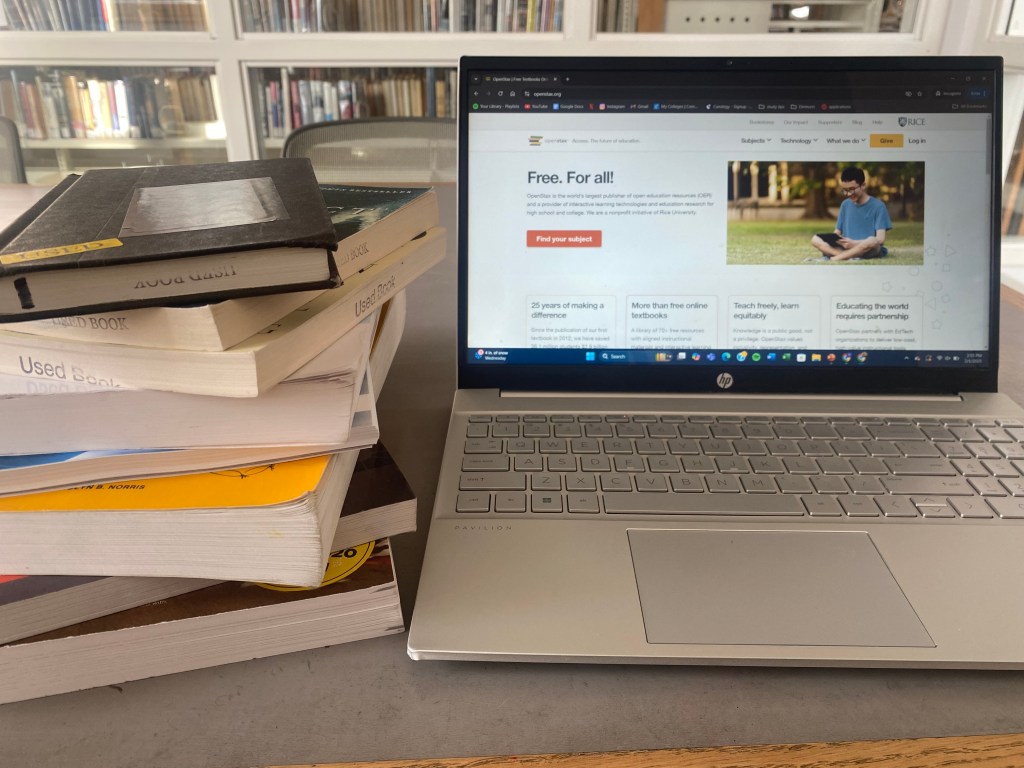
A stack of textbooks sits beside a computer displaying OpenStax, the largest publisher of Open Educational Resources (OER). With college textbook prices rising, OER aims to provide free, accessible materials for students. Photo by Ashley Vanderhoff.
By: Ashley Vanderhoff, Editor-in-Chief
Open Educational Resources (OER) are public domain or open license materials designed for learning, teaching and research. The resources offer access, reuse, adaptation and redistribution at no cost. Unlike conventional textbooks, which can cost hundreds of dollars, Open Educational Resources are free. While full-time universities often offer more specialized and advanced courses, community colleges – with their broad enrollment in general education courses – have seen the most success in adopting OER.
Waubonsee Community College faculty and staff have explored OER independently for many years, but the efforts became more structured and organized with the hiring of Digital Services Coordinator Brandon Board in the summer of 2022. Although the adoption of OER is still in its early stages, with many classes not yet fully integrating these resources, the savings are already striking.
In the Fall 2024 semester alone, Waubonsee students saved a total of $227,000 while utilizing OER instead of traditional materials. Since Spring 2022, the college’s OER efforts have saved students a cumulative $1.1 million.
When Waubonsee Community College started to seriously pursue Open Educational Resources in 2022, the initiative presented a promising solution to the mounting cost of textbooks. For many students, the price of traditional textbooks is a barrier to their education – some skip buying them altogether, fully aware of the academic consequences. Unfortunately, adopting OER isn’t as simple as just choosing free materials. The time, effort, quality and accessibility of OER all introduce potential obstacles. Yet, despite these hurdles, the promise of making education more accessible has inspired several faculty to continue.
Is developing OER too time-consuming and demanding?
Faculty must undergo a process of adapting these free resources into usable course materials. Board explains that this process starts with a conversation—an essential first step to uncovering the resources that could bridge the gap.
“There are several steps, which first involves a conversation with the faculty: What course is it? What are the goals of the course? What are the learning outcomes? Next, we dive in and see what OER materials are available that line up with those [goals]. We see if there are any gaps, or if we can plug it in and go, and then customize and adapt …. We will look at supplemental materials, like homework, PowerPoint slides, tests and assignments,” Board said. “Sometimes, OER doesn’t always have a lot of that stuff ready to go, so the professor might have to develop a lot on their own. Finally, we review and make sure everything’s ready to go …. That’s the general process, depending on the professor and the course they’re teaching.”
The workload involved is no small task. Still, many professors remain committed to making student affordability a priority. Associate Professor of Communications Jennifer McGuire has been inspired to incorporate OER-like materials into her courses since before Waubonsee formally invested in the program in the summer of 2022.
“What really motivated me was the expense of the textbooks and the fact that the publishers constantly change them. I understand they have to change and update every three years, but as I continue to teach in my career, I also noticed that students’ predominant learning style is more of videos,” McGuire said. “I was also finding out that students were not reading the textbook, which motivated me to go to OER, incorporate videos, and write more of my own content in my courses. I think it’s a fabulous thing. It’s a lot of work.”
Waubonsee also employs a large number of adjunct professors who greatly outnumber full-time faculty. These faculty members often rely on textbooks provided by full-time professors due to their intense schedules and limited time for developing their own materials. As a result, adjuncts typically teach using the agreed-upon textbooks selected by full-time faculty in their department. This can present a challenge to the widespread implementation of OER. Board discussed his hopes for greater OER adoption among adjunct professors in the future.
“I’m working on trying to support adjunct faculty better. There are some exceptions, but in general, the way it works is if a full-time faculty member chooses to use OER, then often the adjunct faculty teaching those same courses would be using OER. If the full-time faculty chooses to use traditional textbooks then the adjunct faculty would use that as well,” Board said.
On top of the already heavy workload, implementing OER often requires extra effort that professors must choose to take on without compensation. When asked if professors are paid for the extra time spent on OER development, Board offered his perspective.
“It’s a complicated question. So generally no, professors are not compensated. It’s sort of considered part of their normal job. Part of their job as a professor is to select the materials and get the course ready to go. One of the things that I have been advocating for with our administration is that using OER from a professor’s standpoint takes a lot more work. So I personally think they should be compensated beyond their normal salaries,” Board said. “That’s part of what led to the creation of the professional development institute. Faculty who participate in that do get a stipend for their time. Stipends are something that a lot of schools do to try and encourage faculty to move in this direction. That’s how we’ve tried to implement that here.”
Waubonsee’s professional development institute is a summer program for professors who want to convert one of their courses to an OER format. Faculty learn about OER partly from colleagues who are already teaching with it and serving as mentors. The program highlights different teaching strategies and encourages collaboration between faculty to determine the best ways to teach OER-based classes. Since the institute takes place during the summer, professors typically have more time to focus on developing their OER courses and reviewing their current teaching methods.
Assistant Professor of English Jon Nichols has seen students struggle with financial challenges since the start of his teaching career. Despite the workload, he currently uses OER in his English 101 and 102 courses.
“I think that the benefits of OER really outweigh just about everything else. I’ve had such good luck with it so far that I’m willing to keep trying. That doesn’t mean that we couldn’t run into problems sometimes,” Nichols said. “OER is also more work for the faculty because when we’re trying to find examples of writing for students … that’s on the faculty member to go find, especially in English 101. We’ve got to make sure that the student has access to it and that’s more work, it’s more challenging, but I believe the students benefit.”
How is the quality of OER perceived?
Even after the initial hurdle of course adaptation, the true test lay in ensuring that these materials could compete with traditional, peer-reviewed textbooks. The quality of OER has been a point of skepticism among some faculty—and even students. Board recounted his own experiences with this skepticism.
“I think it was the fall of ‘22, so shortly after I had started, I met with the three students who were working for [the library] to chat about [Open Educational Resources],” Board said. “One of them said, ‘My professors are using this sketchy, free website textbook, I think it’s called OpenStax.’ That’s one of the more reputable OER publishers out there, right? So to me that shows they might be assuming, it’s free, therefore, it’s probably not legit.”
One of the central hurdles OER faces is ensuring that the quality of its materials can match, or even surpass traditional peer-reviewed textbooks. Board spoke about the barriers OER still faces in this regard.
“OER creation is often driven through grants and charitable giving, so it’s a bit like philanthropy. It’s a bit slower to get new content up and out for the general public. A textbook publisher has new editions, and that’s their business. If they don’t have a new book to sell you next year, they’re not going to get a profit,” Board said. “So they are very motivated, whereas, with OER, there’s no profit motive. It’s much slower, and it relies on individual authors who feel passionate and want to publish something in an OER format.”
Assistant Professor of English Todd Laufenberg shared his thoughts on ensuring content quality when asked about the challenges of developing an OER class.
“It’s actually pretty tricky because a lot of the online stuff is uneven, some of it’s not so great, and some of it’s pretty good, but even that stuff has holes in it …. A published textbook that the students have to pay for, in many cases, is more vetted,” Laufenberg said. “There’s a whole team of people working on them to ensure that they’re reasonably good quality, whereas online, you have to be the person when you’re reading those resources to make sure that it’s all appropriate and it’s got the content you want.”
But the quality question is far from simple. OER has several well-funded and well-maintained platforms that aim to ensure high standards. Board pointed to one of these, OpenStax, as an example.
“OpenStax is well-funded, it’s well-run. They’re updating their materials all the time. Other OER content is somebody at some college somewhere, publishing a textbook for their course, and putting it out online for anyone to use. They may or may not update it,” Board said. “And that’s a piece that our faculty have to consider if they find something: how up to date is it? And if it’s not up to date, they can update it, they can revise it. But do they have the time to do that with their teaching load and all their other responsibilities as a professor?”
Are OER truly accessible and usable for students?
While quality concerns with OER could be addressed by focusing on established platforms and allowing professors to revise and update materials as needed, faculty wishing to implement OER must also consider the potential unintended consequences for students. One concern is whether students read as effectively on screens as on paper. Laufenberg shared his thoughts when asked if he believed OER could present challenges for students who struggle with reading on screens.
“I do think that online reading tends to skim a little bit more, and you can’t take notes in the margin in quite the same way. I know there are tools for that, but I think that a lot of the time, with online reading, people treat it a little bit differently from paper books,” Laufenberg said.
A key advantage of OER, however, is that while the materials are often online, students can print as much of the content as they need. Board explained the flexibility this provides.
“We also have freedom in how we use them. I don’t know if you’ve ever tried to access an ebook from the library and tried to print off something, and you get like a 30-page limit. You don’t have any of that with OER. You can print off as much as you want,” Board said.
But it’s not just the students who benefit from the flexibility OER offers. Board expressed excitement about the door OER could open for faculty too.
“The flexibility that it provides faculty to make revisions to the materials allows them to align the content more fully with the students they have in the class. They can localize it to our context here at Waubonsee. So being able to bring more students in and give them access to information and education, but also customize it to make it really apply to them,” Board said.
Still, some professors worry that it doesn’t provide enough opportunities for students to receive immediate feedback. Board shared a conversation he had with a professor facing this exact challenge.
“I had a conversation with a professor a couple of weeks ago who had been using an OpenStax textbook, and she agreed that OpenStax was fine, but she felt that her students needed a bit more immediate feedback,” Board said. “Like when you answer questions, and the homework platform confirms what you did right or what you were missing. OER is coming along. It’s getting better than it used to be in terms of those types of things, but it’s still behind the commercial materials in that regard.”
Despite the barriers, Waubonsee is steadfast in its commitment to making OER a transformative, high-quality initiative. As the program continues to evolve, it promises not only to save millions of dollars for students but to redefine the very idea of accessible education. Board reflected on the impact.
“I think that OER is a really cool solution that checks a lot of boxes. This fall, we crossed the one million dollars saved mark. Again, a million dollars that never left students’ pockets is just really cool,” Board said. “I think that’s what excites me, is that it has the opportunity to make education available and affordable for more students and also make it better at the same time.”
For more information, you can visit waubonsee.edu/mymaterials.
 Waubonsee Weekly
Leave a comment