

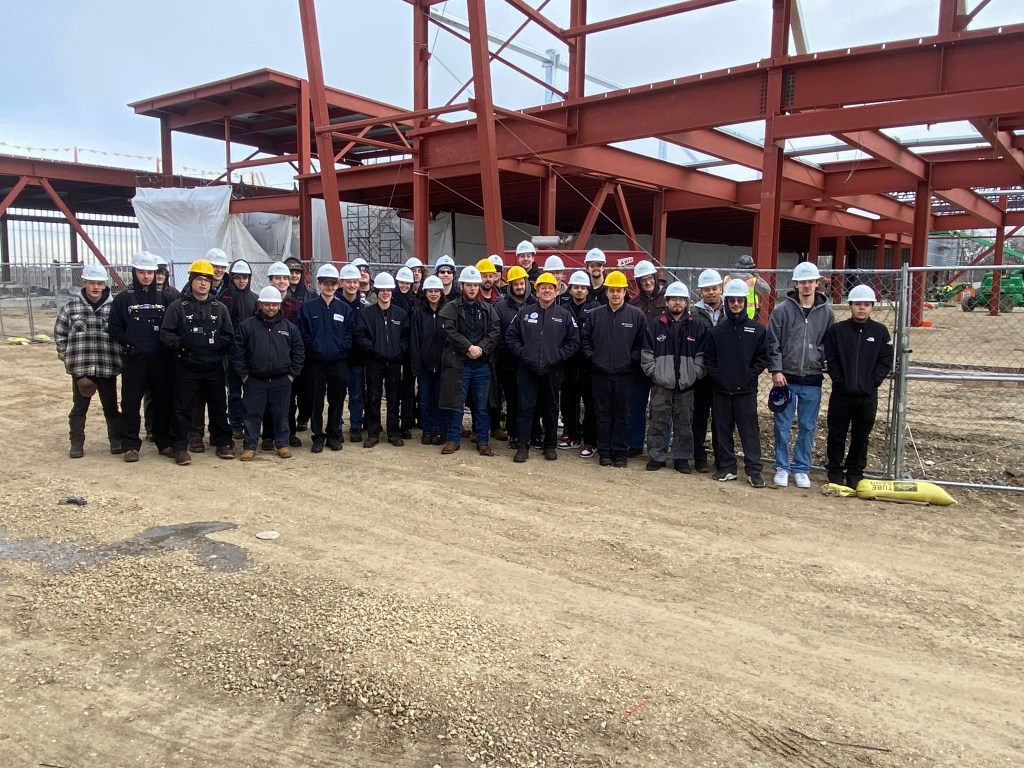
Students from the Automotive Technology and the Collision and Refinishing Technology programs gather in front of the Technical Education Center, which is currently under construction. The new facility is set to open for the Fall 2025 Semester. Photo by Ashley Vanderhoff.
By: Ashley Vanderhoff, Editor-in-Chief
Waubonsee Community College’s Sugar Grove Campus will open a new building in time for the Fall 2025 semester. Located near the south entrance visible from Route 47 and Waubonsee Drive, the $60 million, 100,000-square-foot Technical Education Center (TEC) will help meet the growing demand for skilled technicians by expanding capacity and enhancing workforce training. The new facility will house programs in Automotive Technology, Collision and Refinishing Technology (Auto Body Repair) and Welding Technology, along with general classrooms, computer labs, office spaces and areas for common use, support and collaboration.
The building plans include larger labs equipped with advanced technology to boost enrollment and foster expansion in key areas such as diesel technology, electric vehicles, welding fabrication and robotic welding. These upgrades will allow the programs to grow and offer students more opportunities.
The project stems from a rising demand for technicians in the workforce. Waubonsee’s previous facilities for these programs could not keep up with the growing enrollment and workforce needs. Assistant Provost of Workforce Development Ne’Keisha Stepney emphasized the need for expanded capacity.
“I’ve counted the many times when enrollment opens, and on that first Monday in November or May, classes in [Automotive Technology] fill in five minutes or less,” Stepney said.
This trend in enrollment reflects the personal challenges faced by students, as Automotive Technology student Joshua Stover explained.
“It is always a race to enroll in automotive courses, and while I have been fortunate enough to have gotten into every class I’ve signed up for, I know many people who could not and had to take extra courses in their second year to be able to graduate on time,” Stover said.
The demand for these technicians extends beyond the classroom and into the workforce. Associate Professor of Automotive Technology Guy Tiberio highlighted the critical role these students play in a variety of industries.
“We have students in so many industries that’s not just fixing cars, but are automotive related or transportation related logistics,” Tiberio said. “We have students who work for the post office, UPS and FedEx. People don’t realize that for a package to go from Amazon’s or FedEx’s warehouse to your house, someone has to drive it there, and someone is maintaining that fleet of vehicles. Our students are the ones with the skill set to do that.”
In addition to the large workforce, Stepney emphasized the need to train more technicians to replace those retiring from the field.
“It’s an aging industry, and we need to get younger people into the industry to offset the loss that’s occurring,” Stepney said. “But it’s occurring at such a rapid rate, and then the technology advances at such a rapid rate that we have a skills gap because there’s not enough people to fill those opportunities. The expansion of our capacity is going to allow us to serve more students, thus turning out more of tomorrow’s technicians.”
The new building will also give Waubonsee students the opportunity to work with cutting-edge technology and industry-standard equipment, preparing them for the workforce. Tiberio described how these improvements will directly benefit students.
“We are almost tripling our bays to allow more students to work more independently and to have more live work in the shop,” Tiberio said. “We’re adding a diesel lab and an electric vehicle lab to expand on our current offerings to get students a little bit more in-depth with the training and work on those types of vehicles. We’re getting more modern equipment that [students] are going to see in dealerships and shops they will be working at. So our goal is to make sure that whatever they’re expected to do out in the industry, we’re setting them up to do that in our program and making sure they’re getting those experiences here.”
As a student deeply involved in the program, Stover is particularly excited about the opportunities the new building will provide. He shared his thoughts on how it will enhance the learning experience.
“I think that the most beneficial part of the new TEC building will be access to new tools and machines that will be needed in the ever-changing automotive world,” Stover said. “For example, there will be an [Advanced Driver Assistance Systems] room in the new shop that will allow the students to work on newer self-driving cars, where our current shop lacked that ability.”
Beyond the technical training, the TEC building will also provide spaces for collaboration and focus. These spaces will allow students to relax, study and engage with their peers, while also facilitating interaction with other colleges. Stepney highlighted the importance of these additions for both students and faculty.
“This space will support everything the Auto Tech programs do and provide a better facility for them to do that type of work in,” Stepney said. “We will be able to host people now. The Automotive Educators Conference happens every year and the college has not been able to host due to space constraints. We now look forward to being able to welcome folks into our new facility for that conference.”
The development of the TEC building has been a long-term process, some believing it’s true start to be around three decades ago with faculty member Ken Kunz. Tiberio spoke about the dedication of Kunz, his colleagues, and the entire team to the project.
“Myself and Tyler Friedland, one of our other full time instructors, have been involved since the beginning – meeting with architects and engineers, going through design, telling them the needs of the program and the needs of our students to make sure that all those are being considered in the design of the building,” Tiberio said. “But the actual start of this was started many, many years ago by another instructor Ken [Kunz], who built this program with another instructor named Jim [Armitage] into what it is today, and built the popularity of the program that’s actually requiring the use of this building.”
The project is a culmination of work by Waubonsee administrators, faculty and community members. Tiberio reflected on the community’s support for the program.
“Once people started realizing there’s a lot of people that want to get in this program, and we can’t meet the needs, we started having industry members come to our advisory meetings saying they would hire 50 more students if we could get 50 more students through the program,” Tiberio said. “I think over time more people started hearing these stories about the need, and how many people want to come here and want to go through our program. I think that’s what made people think we need to do something about this.”
Once the TEC building is completed, the Automotive Technology, Collision and Refinishing Technology (Auto Body Repair) and Welding Technology programs will be located in the new space, which offers expanded capacity and opportunities for programmatic growth. Stepney shared her hopes for the now-vacant spaces.
“There are other CTE programs like Automation Technology, Computer Aided Design and Drafting, Heating Ventilation and Air Conditioning and Machine Tool Technology offered out of Akerlow and Weigel Halls,” Stepney said. “We will discuss space allocation and expansion of these programs that are in high-demand fields that will also need modernized facilities to meet industry demands.”
For more information visit waubonsee.edu/TEC.
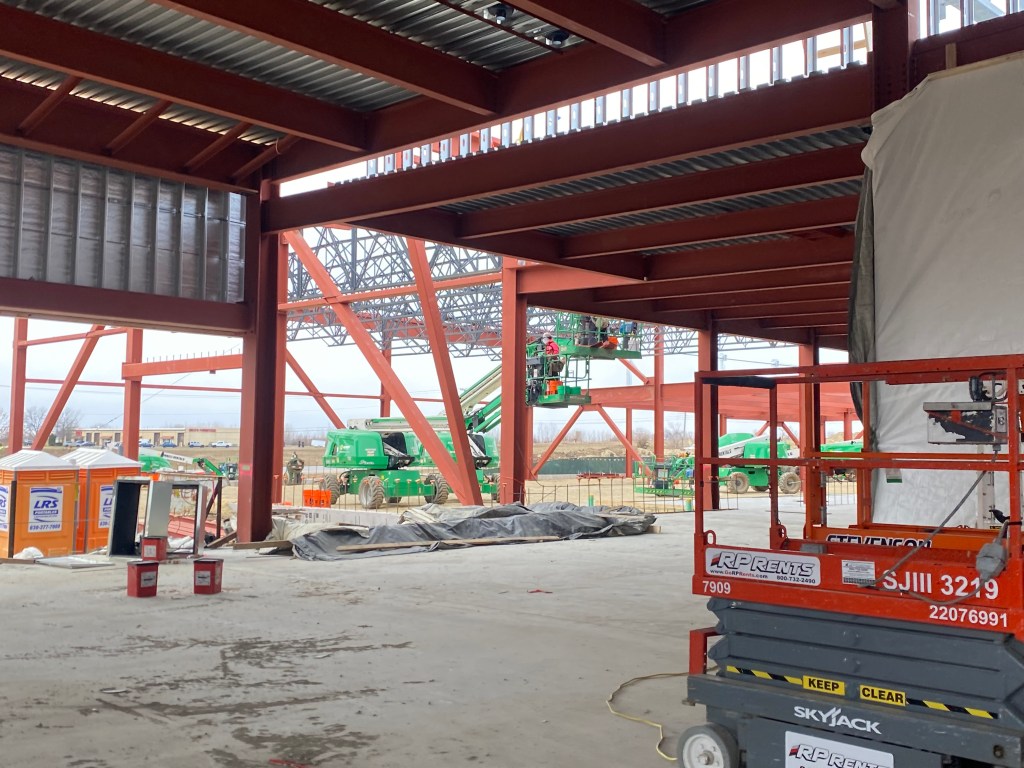
This photo was taken in December 2024, showing the ongoing construction of the new TEC. The 100,000-square-foot building will house the Automotive Technology, Collision and Refinishing Technology and Welding Technology Programs. Photo by Ashley Vanderhoff.

 Waubonsee Weekly
Leave a comment