

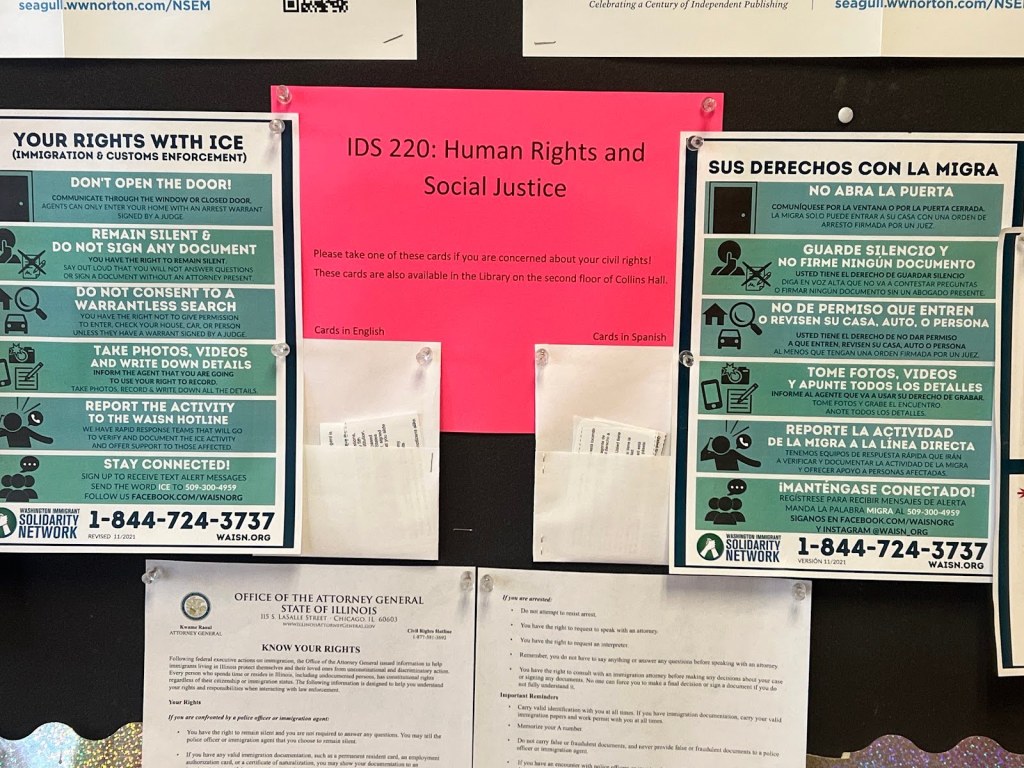
The Human Rights and Social Justice class at Waubonsee set up informational cards and posters. The posters allow students and staff to learn about their rights regarding the current ICE raids in the United States.
By: Itzel Gutierrez, Social Media Executive
With the current rise of anti-immigrant policies, first-generation students face the crisis of loss of belonging – while watching their families being torn apart and futures being uncertain with mass deportations.
The targeting of undocumented immigrants was a promise that President Donald Trump made throughout his campaign. Now taking over office for his second term, Trump took it upon himself to quickly begin his expedited removal plan by signing 10 executive orders on immigration and issuing proclamations to carry out his campaign promises of mass deportations and border security.
Although these raids were inevitable – as they were a pivotal part of Trump’s campaign – the rapidity of the actions that were taken by ICE workers was unexpected. While some of these actions have an immediate impact, such as the mass deportations, some are facing legal challenges and may take years to fully unfold. Now, with the raids moving swiftly across the country, many immigrants live in fear of what their futures hold.
Professor Todd Laufenberg at Waubonsee addresses the problems with mass deportations, and the risks that these actions can have on legal immigrants.
“The first problem with mass deportations is the ‘mass’ part,” Laufenberg said. “Any time the government tries to use law enforcement in a large-scale operation, they risk making mistakes and harming people who have full legal rights to be in the U.S. Some might even suggest these ‘mistakes’ are intentional, designed to generate fear in immigrant communities—even among those who are 100% legally allowed to be here.”
The problems surrounding these mass deportations raise questions about where the line should be drawn regarding who is being deported. Some asylum seekers now live in fear while facing the risk of being deported, despite being granted temporary protected status.
“When people who fear for their lives in dictatorships like Venezuela or collapsed states like Haiti try to come to the U.S., we’ve historically acknowledged our obligation to take them in and provide them asylum,” Laufenberg said. “Now, many of these refugees worry their applications will be rejected en masse, leading to deportation—even though they are not in the country illegally.”
This issue of who has the right to stay and who faces the threat of mass deportations leaves immigrants, even those living here legally, feeling confused and fearful. Although the Universal Declaration of Human Rights (UDHR) outlines the rights that everyone should have, these rights have not been universally ensured, as shown by these mass deportations, and the challenges that the Trump administration has made towards the removal of birthright citizenship.
Not only are these national issues, but state and local governments also play a crucial role in shaping immigration policies. Waubonsee Professor Rich Keifer points out that main cities, including Chicago, have declared themselves sanctuary cities, refusing to use local law enforcement to enforce federal immigration laws.
“Legally, there’s a precedent where you can’t compel states and local governments to use their resources to further a federal government policy,” Keifer said. “But the difference now is that the current administration has a big megaphone, and they’re making it sound like states and local governments are standing in the way of enforcing these federal laws.”
This brings in the concept that the federal government is ultimately framing these deportations in a way that pressures state and local authorities, creating tension over enforcement priorities. While the tension between federal and local government rises, communities face the consequences of a climate of uncertainty and fear.
Freshman student Bryan Medina speaks up about the instability caused by these policies, which has led students to rethink their futures for their families’ benefit.
“There is a special case for someone very close to me, also a first-generation student. They have now completely removed the idea of pursuing a bachelor’s or transferring to a four-year institute anytime soon.” Medina said. “It’s easier for them now to finish their associate’s and aim for a job since these policies have placed a strain on the already demanding life they maintain.”
The college has been updating employees and students on their own protocols through Vice President of Talent and Culture and Chief Diversity Officer Anthony Ramos and Assistant Provost of Student Services Dr. Scott Peska. In a special board of trustees meeting on Feb. 5, President Dr. Brian Knetl outlined the college’s approach to managing the uncertainty surrounding some executive orders.
“We’ve been sharing protocols regarding any activity on any of our four campuses related to federal law enforcement activity,” Knetl said. “I feel very confident that we have really strong protocols in place, and we are reinforcing those protocols with our college community, so that if something on any of our campuses were to happen, our police department would be best equipped to facilitate any of that activity.”
In a country known as a nation of immigrants, people fail to see that the opportunities that accumulate of the “American Dream” are being taken away from them. Not only are these policies creating a strain within immigrant communities, but they’re removing the sole reason they came to this country. The way these deportations are going about ultimately do nothing but create fear and have a large financial burden.
“A more compassionate approach would allow more people to immigrate legally, provide amnesty for those who have lived here peacefully, and ensure work permit holders and undocumented individuals have basic rights.” Laufenberg said. “At the very least, we must stop punishing people simply for seeking a better life.”
 Waubonsee Weekly
Leave a comment