

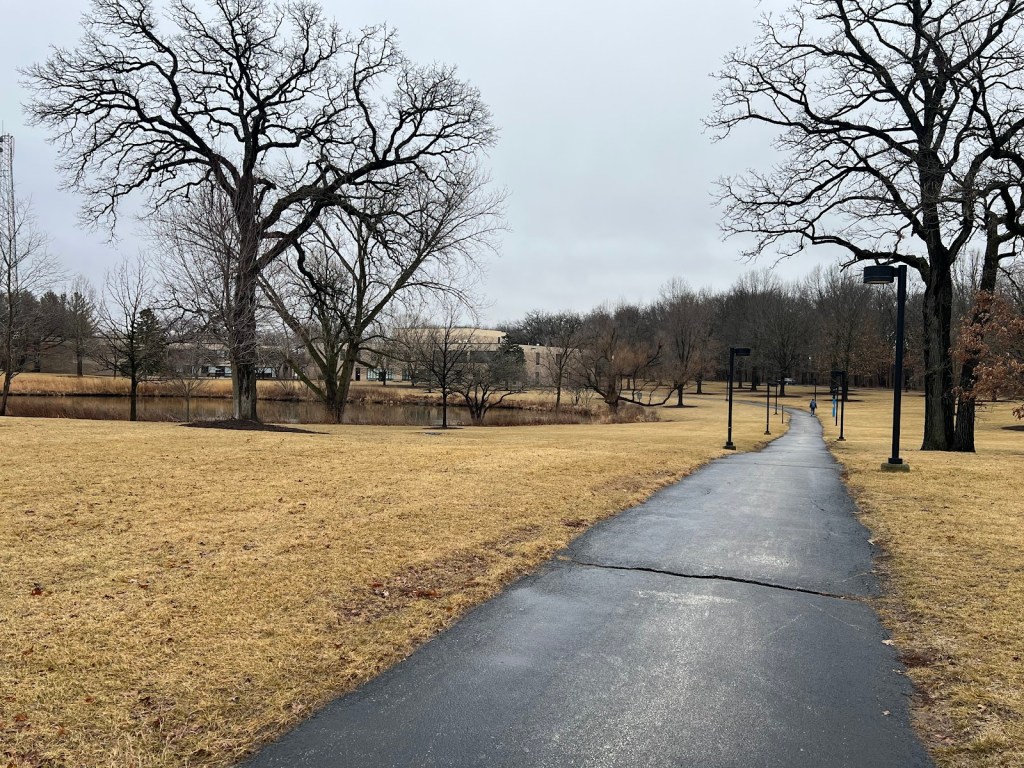
The path between the Academic and Professional Center and Bodie Hall is one that is quite scenic but also rather long. It is one of the fastest ways to get between the two, but still requires students to walk through a parking lot and takes many minutes.
By: Kevin Sigrist, Editor-in-Chief
When navigating Waubonsee’s Sugar Grove Campus, many features promote ease of movement. Whether it be a wide availability of parking lots, interconnected buildings or a variety of sidewalks and paths to take, there is a general sense of walkability on the campus. Walkability, which means the accessibility of a community’s amenities by foot, is an incredibly important concept in modern urban planning and infrastructure, especially in places like densely populated urban areas including college towns and campuses. That being said, while it is clear that Waubonsee Community College has put in some effort to create walkability, it has areas that are in need of improvement or are yet to have even been introduced.
Some examples of walkability in a living community include being able to walk from your home to get food or groceries, attend events or entertainment and having easy access to natural environments. In a school setting, it includes things like being easily able to walk from one end of a campus to another, navigation through the various buildings being simple and easy to understand or useful resources like the campus library and gym being located near the highly trafficked buildings such as ones where lectures are held. As rarely discussed of a topic walkability is, it can make or break the sense of a community in a given area.
Walkability also has many environmental benefits. According to the United States Environmental Protection Agency (EPA), 28% of all greenhouse gasses in the United States in 2022 were created by transportation, and of that 28%, 57% were produced by light-duty vehicles. It is obvious that traveling to the Waubonsee Sugar Grove Campus requires the use of a car, but once a student has arrived on campus, it is up to the development of walkability to reduce the overuse of a car from there, stopping students from relying on their car to navigate to classes and such.
“When I met my husband, he lived in Oak Park, and he currently still works in the city and so I think walkability was really important to us because not only did it us allow us to go to places like, you know, Target or Trader Joe’s for groceries, but then we could go do social things as well, you know, go out to a restaurant or see a movie or whatever, all by walking,” Professor of Biology Dani Fischer said.
Fischer, who moved from Yorkville to Elburn for the sake of accessibility to the train station and other walkable features, still finds walkability in the suburban towns to be inefficient.
“Elburn is more walkable than Yorkville, but I wouldn’t call either of them a walkable community. Like, I have to get into my car every day to go to work. I only live seven miles away, but even if I was fitter than I am, it wouldn’t be safe for me to ride my bike on Route 47 to come here,” Fischer said. ”So I would say walkability would be a priority, but to me, I’m not going to move to the city to experience that because I think there are other cons of the city. I just wish the community I lived in provided more walkability.”
So why is walkability important on a college campus, especially at the community college level? Well, when it comes to community college, it is incredibly common for students to be older, already in a career or simply attempting to advance their career and are achieving more education to do so. Because of this, schooling is often not the primary focus in these students’ lives, making it incredibly difficult to get students to attend events, take advantage of the various utilities, explore the many recreational or work environments or generally participate outside of attending class. Strong walkability creates an environment where the access to amenities is so abundantly available that it would be difficult to actively avoid, making it a natural process for students to become incredibly engaged.
And this relation is mutually beneficial between the college and its students. In an article by the Journal of the American Planning Association, through research and studies, they found that “a significant number of people are happier if they live in attractive, walkable places that enable social connections and trust in others.”
This idea is also ultimately far more difficult for community colleges versus four-year institutions because these universities and colleges have to provide essential infrastructure such as housing, dining halls, and much larger fitness and recreational facilities. Despite this, if walkability is strongly established on a community college campus, students will utilize far more school resources, attend more events, participate in far more extracurricular and recreational campus activities and the campus can experience a far stronger sense of community.
While this story will ultimately discuss some flaws with the Sugar Grove campus, Waubonsee Community College is not anywhere near a failure when it comes to walkability. The campus is full of many features that make it accessible, efficient and even exciting to explore.
The Virgil L. Gilman Trail, an 11.3 mile path that begins at Waubonsee and goes all the way into Aurora and across the Fox River, is one of these features. The path travels through various different scenic areas and passes over many busy roads with beautiful bridges. The Virgil L. Gilman Trail makes it possible for residents in Sugar Grove and Aurora to bike or walk to the campus, given enough time. The trail also connects with the Fox River Trail, a 45.7 mile long trail that travels north along the Fox River. The campus is also surrounded by forests that students are able to be in and explore, promoting more recreational activities on campus.

The Waubonsee entrance of the Virgil L. Gilman Trail is on the outside of the Student. The trail stretches across a beautiful prairie before reentering the woods and eventually uniting with Kedeka road.
A non-walkability transportation strength is the accessibility to parking. Every building on the Sugar Grove Campus has a parking lot very near to the building, without exception. This makes looking for a parking space for extended periods of time a futile worry, reducing emissions and increasing the ease of use for Waubonsee students.
One of the best walkability features at Waubonsee is the hallways that connect the different buildings together. On the north side of campus, tunnels run connecting the Science Building, Akerlow Hall, Weigel Hall, Collins Hall and the Auditorium. On the south side, a hallway runs connecting the Dickson Center and Bodie Hall. These connectors very well may be Waubonsee’s strongest walkability component. They make the buildings feel interconnected, promote students to walk through them and discover areas of campus they have not seen before and they allow for students to be sheltered from the elements when navigating through campus.
All of these very strong components to the Waubonsee system of walkability do great jobs of promoting students to utilize more of the campus and engage with other students. According to an article by the National Library of Medicine titled “Walkable communities: Impacts on residents’ physical and social health,” that interprets data from a Texas A&M study on walkability, “In terms of social health, automobile-oriented communities tend to ignore the needs of pedestrians and make everyday life dependent on automobiles, which in turn reduces opportunities for social encounters and interactions in neighbourhoods. Limited studies suggest that walkable communities promote social health by encouraging walking and other outdoor activities, and thereby, facilitating social interactions among neighbours.” While the study discusses neighbors in living communities, the same line of reasoning can be applied to a college campus as well. Students are simply happier, more engaged, have a better time on campus and are more likely to spend more time on campus if walkability is achieved.
Now that Waubonsee’s strongest walkability components have been discussed, there are lots of improvements that can be made, as well as a few flaws that are generally unavoidable. It is important to look at this like improvement or optimization as opposed to intense overhauling. Waubounsee does generally have a walkable campus, but it can be so much more than it already is.
The one massive problem with the campus that jeopardizes functional walkability for many students is how intensely the campus is spread out. Two of the most attended buildings on the campus, the Academic and Professional Center (APC) and Bodie Hall, are on opposite sides of the campus, with at least a five minute walk to travel between them. This would not be a problem if not for two reasons. For one, most general education courses are held in these two buildings, leading to the commute between them incredibly common for students. Secondly, it is significantly faster and easier to simply move your car from one parking lot to another, which is quite literally antithetical to walkability.
This problem is not limited to these two buildings. While in the midpoint, Erikson Hall, the hall with many recreational activities such as the fitness center, is very disjointed from the rest of campus, making it difficult for students to discover and utilize the opportunities offered there. While it is not to as high of a degree, the Student Center also suffers from this problem. Most students are often traveling between Bodie Hall, APC and the science building. Collins Hall, the building that holds Todd Library, is along the way between these buildings, creating the ability for students to utilize it for homework and studying. The student center, which also holds a large seating area, many computers for homework and even a cafe and Paisano’s Pizza and Grill, is somewhat out of the way for many students, being off to the side of Bodie Hall.
One simple and sustainable way that Waubonsee could solve this problem is by connecting the Student Center and Collins hall with some form of tunnel or middle building, which was actually something that was planned for a period of time in Waubonsee’s past, known as the Student Hub, but plans ultimately did not come to fruition due to COVID-19.
“[The Student Hub] wasn’t just like a tunnel, like picture like a hamster tunnel, but they were gonna have the student life offices there. And so just like [path connecting Bodie to the APC] forces people to interact with nature, I think they were trying to do the same thing, forcing people to engage with Student Life because it was gonna be in this high traffic area,” Fischer said.
The Student Hub, which has a virtual tour available at http://youtube.com/watch?v=1ENNBmIigGA, contained various attractions such as massive views of the wetlands through a boardwalk, a student lounge area, student senate meeting room, study bays and ultimately connected to the student center near the outside pavilion through one of the cafeteria exits.
Fischer commented on how the spread out nature of Waubonsee’s Sugar Grove campus leads to students not engaging with the many nature features available.
“It’s so spread out. And I think that’s the downside of walkability on our campus. But to me, it’s balanced with other features like access to nature and like Blackberry Creek on our north campus and the Prairie and Virgin Gilman Trail,” Fischer said. “With the [Virgil L. Gilman Trail] on one side and northwoods and Dixon woods like on three of the sides, the students aren’t forced to engage with those, and so when I take my students out to the northwoods, they’re like, ‘I’ve never been here before. Are we allowed to go here?’ And I’m like, of course you’re allowed to go here – it’s on campus,”
Fischer elaborated on how the spread out strictly forces engagement with other features of campus in negative ways, which is generally something that should be avoided as it can build disdain with students.
“We force students to engage with the campus by making it so spread out. Like, I think you can’t avoid places like Huntoon Lake because you’re forced to walk from northside to southside,” Fischer said. “There’s only one way to drive from the north side to the south side. It’s not a circle, and so I see many students walking north side to south side, so I think we force interaction with the campus.”
This claim may seem contradictory in the idea that good walkability makes it hard for students to avoid the certain features of campus, but this example of Huntoon Lake can be a drawback because it is one of the only options students have as a means of moving between these buildings. Establishing many means of transportation is a strong component of walkability.
Adding onto Fischer’s claim of the campus not being a circle, if Waubonsee were to connect its Student Center and Collins hall parking lots, the campus would go from essentially being a “C” to a circle. The fact that the campus is not a circle breeds a lot of difficulty with transportation, and decreases a students’ ability to explore more of campus. Because the campus is a “C” shape, students will very rarely go to the northeast area of campus unless parking in the Collins Hall parking lot, which is very inaccessible given it is a dead end. Adding a connector between the two parking lots would promote easier transportation, more positive traffic towards the Auditorium, athletic fields, and Erickson Hall. The creation of the Student Hub could also have solved this problem.
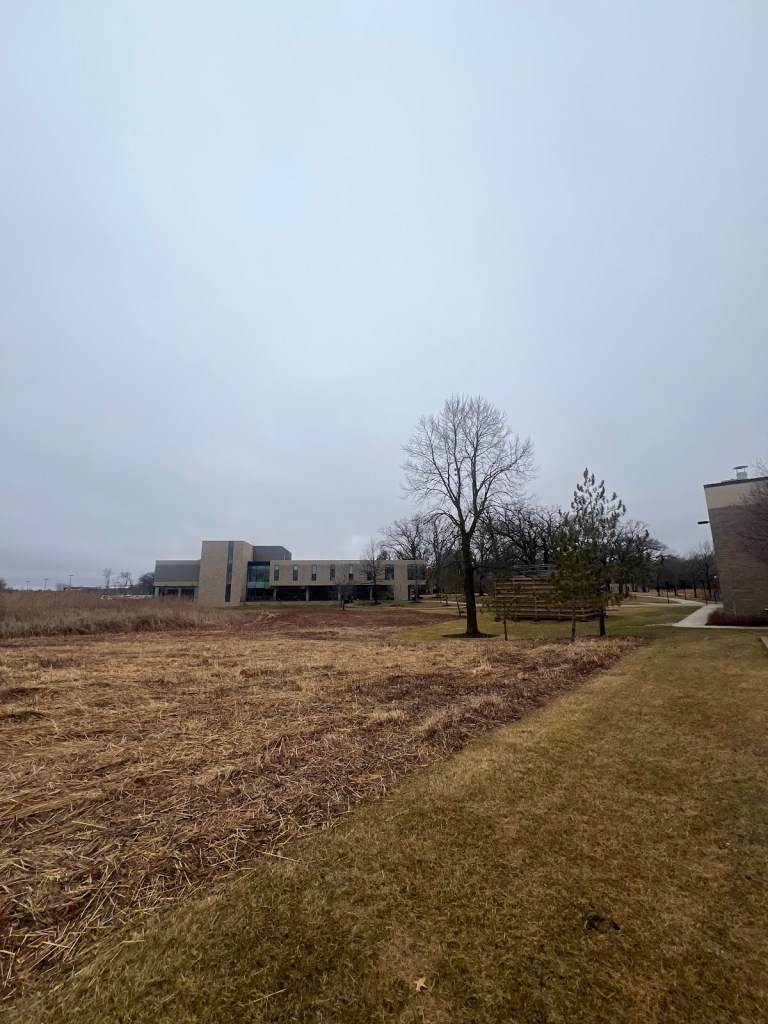
The field that blocks the connection between the Student Center parking lot and the Collins Hall parking lot is one that is quite scenic and large. Creating a road connection between the two would not compromise very much of the field and would create a vast amount of improvements for students, and if that is not possible, the resuming of the plans for the Student Hub would also solve this problem of engagement with the Student Center.
On the topic of roads and parking lots, while the wide accessibility of parking lots is a general positive, as Waubonsee’s student body continues to increase, these parking lots are beginning to fill up rather quickly each day, causing students to idle through the lots waiting for spots to clear up. This problem was especially evident the day of Waubonsee’s spring engagement fair, as almost the entire parking lots of S1, S2 and S3 were filled with students. This is a common problem during the first few weeks of every semester, especially during the 9:30 AM and 11:00 AM classes. This is a problem whose solution is not easily identifiable, but it can be eased through general improvement of walkability and campus transportation, as students will not rely on needing to park directly where their activity, club or class is being held.
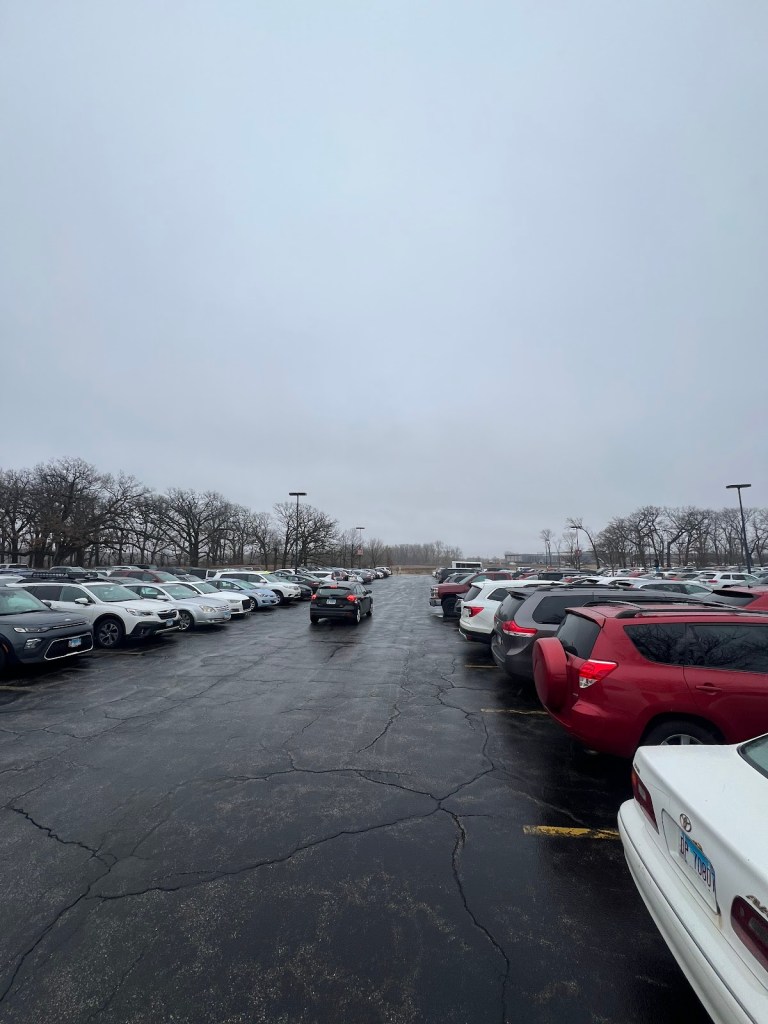
The Student Center parking lot entirely filled in the afternoon of Mar. 5. This parking lot is often a common place for students to park, but has begun to be a problem as it fills up rather quickly.
One serious problem that needs to be addressed is some of the campus’s uneven sidewalks. Many sidewalk tiles are criminally uneven, leading to many students tripping. One specific location outside of Collin’s Hall has claimed many victims, including Diana Fortier, a former economics professor at Waubonsee, as Fischer explains.
“I think with the shifting of the ground… there isn’t alignment between the sidewalk tiles. A past teacher here, Diana Fortier, broke both of her wrists when she tripped on campus. So, like, I think if [campus] is going to be walkable, I think the surfaces definitely have to be maintained, and it’s other small things like weather events, you know, like that really icy day,” Fischer said. ”If you want a campus to be walkable, you just have to be on your total a-game for things like that.”
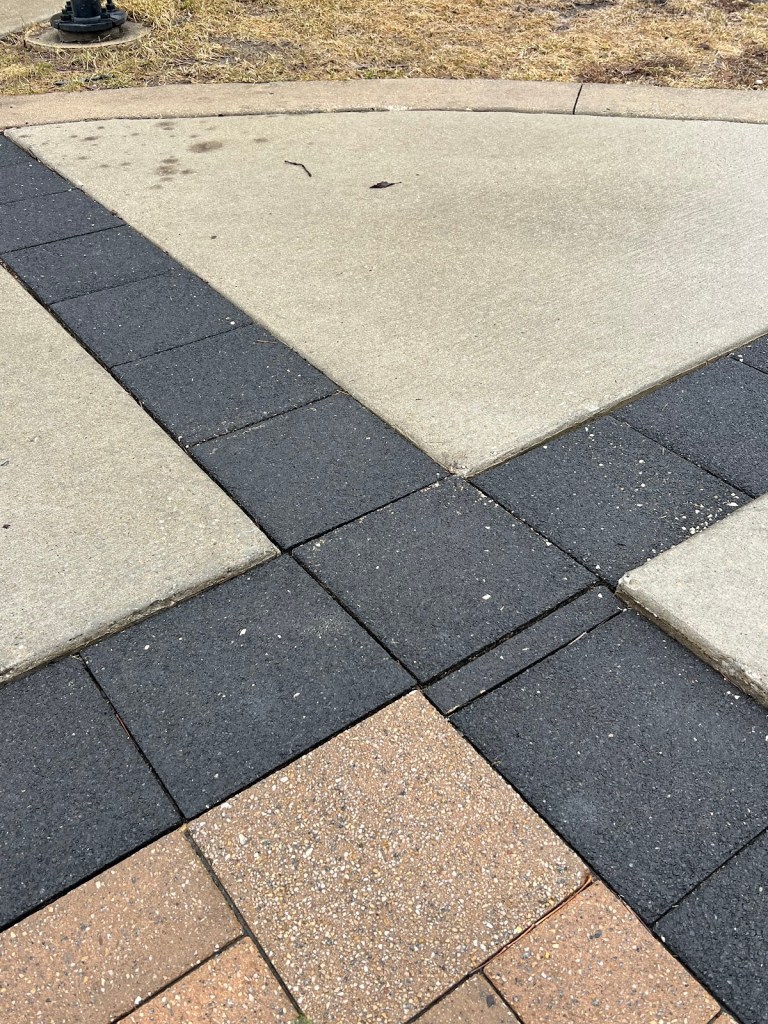
The pavement outside of the Collins Hall is tragically uneven. This has led to many students falling or tripping over and getting injured.
One of the potentially most revolutionary improvements Waubonsee can make is the implementation of bike infrastructure. Introducing bike lanes and racks, which Waubonsee lacks both of entirely, would promote students to bike to campus and introduce a whole new method of transportation that reduces environmental emissions and promotes socialization.
“I see people bike from the Virgil Gilman Trail to the north side of campus, which is fine. That’s great. I’m glad they’re here, but I wish there were bike dedicated surfaces or bike racks on campus so that the walkability could be separate from the also-environmentally-friendly bikeability, but just so they don’t overlap. So it’s not dangerous for the walkers or the bikers,” Fischer said.
There are also many different random inconsistencies of places where the campus could use sidewalks. Certain areas surrounding APC as well as the Henning Academic Computing Center are in need of an increase in sidewalk coverage. Specifically, the Henning Academic Computing Center only has sidewalks from the Huntoon Lake trail, and APC’s doors are restricted to only a few sidewalks, leading to people who park in the back parking lot to potentially walk on the lawn in order to reach a door quicker.

This is an example of a sidewalk or path that leads to nothing. These are not common at Waubonsee, but APC is in need of an increase in sidewalk transportation, specifically in the back of the building where there are only two doors and students often have to walk on the lawn to take a more efficient path to the door.
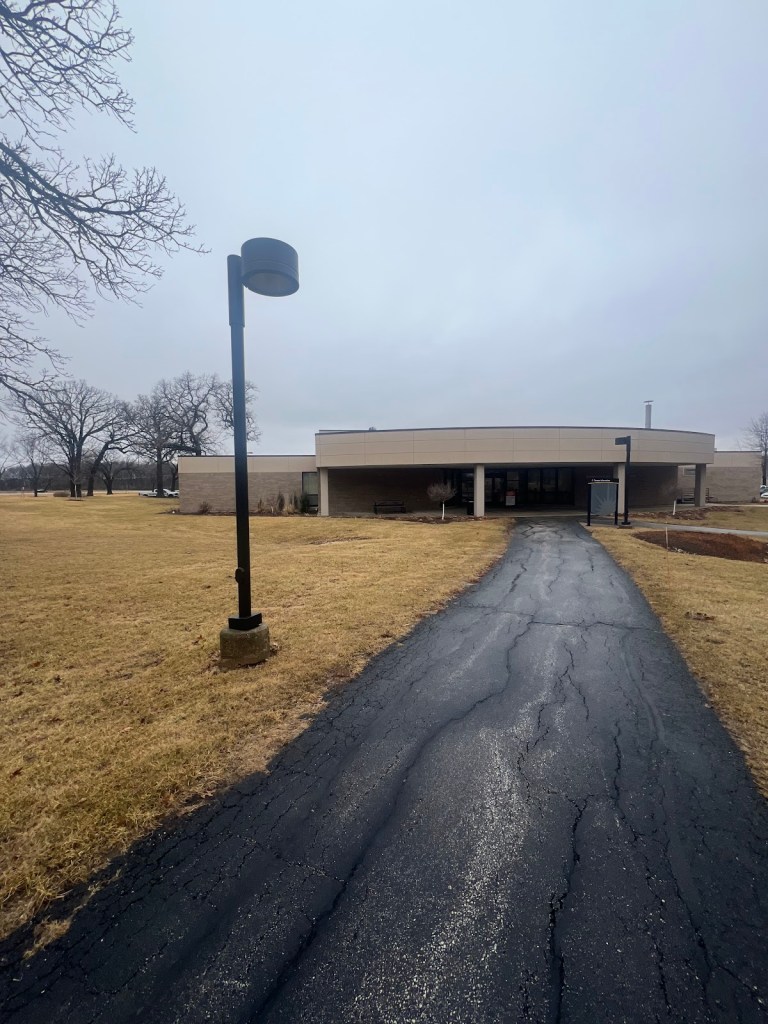
The path that connects the Academic and Professional Center and Bodie Hall ends at the Henning Academic Computing Center. This building only has sidewalks on one side and is very often closed, leading to students having to either walk on the grass or take a relatively timely reroute if their car is in the back of the parking lot.
Given the long list of problems and areas of improvement with Waubonsee’s walkability, what problems do these flaws cause? Well, a lack of walkability, specifically in the case of Waubonsee’s Sugar Grove campus, is that it promotes students to not engage with areas such as the Student Center, Weigel Hall or Collins Hall, and encourages students to simply drive their car around the campus as opposed to walking from building to building, which creates traffic, chaos in parking lots and the obvious problem of the environmental impact.
So, if Waubonsee wants to solve this problem, where should they start? I would recommend the implementation of bike lanes and racks, as well as a road connector between the Student Center and Collins Hall parking lots or resuming planning for the Student Hub. These two implementations alone would increase the ease of transportation and engagement with the areas of Waubonsee that are not seen enough, especially the Student Center and Erikson Hall, two of the campus’s best buildings that currently feel quite tucked away.
Walkability is an incredibly important facet of modern urban development. It promotes engagement, social interaction, and makes those that exist in the area have a better time when navigating. It is crucially important at a community college level, and is something that Waubonsee’s Sugar Grove Campus only slightly succeeds at, but this does not mean it does not have the ability to do much better. Despite the far separation between important and highly trafficked buildings, small improvements like an increase in sidewalks, bike infrastructure, building connections and the adding some form of connection, whether a road or the Student Hub, between the Student Center and Collins Hall could entirely overhaul Waubonsee’s entire walkability situation.
 Waubonsee Weekly
Leave a comment