

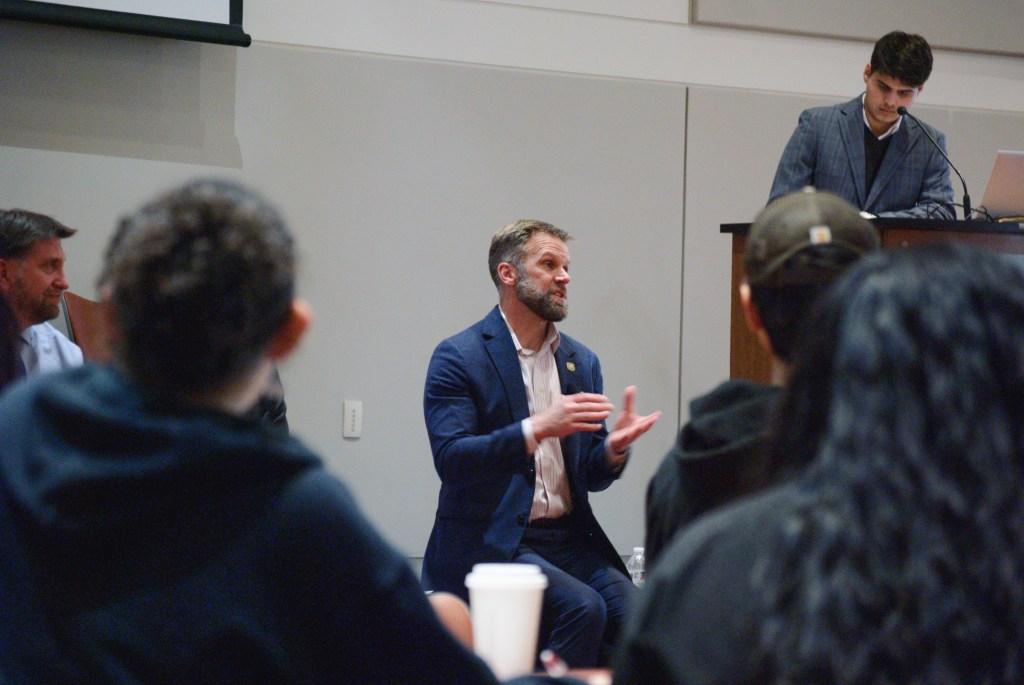
President Dr. Brian Knetl answers students’ questions at a Town Hall Meeting. The meeting began with a resource fair and light refreshments for students.
By: Ashley Vanderhoff, Editor-in-Chief
Photos By: Jacob Pacheco, photography executive
On Monday, March 10, the Student Senate hosted a Town Hall Meeting at the Waubonsee Community College’s Sugar Grove Campus in the APC Event Room from 3:30 p.m. to 5:00 p.m. The event began with a resource fair offering light refreshments, followed by a Q&A session where President Dr. Brian Knetl and members of the College Executive Team answered questions from students. Students had the opportunity to submit questions in advance and ask them live.
The resource fair, open from the start of the event until 4:00 p.m., featured booths for Student Life, Student Senate, the Dean of Student Engagement, Work Matters, the Libraries, Money Matters, the Tutoring Center, Financial Aid, the Waubonsee Bookstore, the College Level Examination Program (CLEP) and the Peer Support Leaders.
A few minutes after 4:00 p.m., Student Senate President Mark Price announced the start of the Q&A. He emphasized that this was the first Town Hall in at least five years and highlighted the Senate’s goal of allowing direct engagement between students and college leadership. He also thanked the attendees for participating. Price then introduced Knetl and the executive team in attendance, including Vice President of Talent and Culture & Chief Diversity Officer Dr. Anthony Ramos, Executive Dean for Student Success and Retention Dr. Lisa Richardson, Dean for Student Engagement Jami Hinshaw, Assistant Provost of Teaching and Learning Sharon Garcia and Assistant Provost of Student Services Dr. Scott Peska. Price reminded attendees to remain respectful, avoid interruptions or profanity, and stay on topic. He began the Q&A with the pre-submitted questions addressed to Dr. Knetl and the executive team.
Q: When will the daycare open for education majors to utilize as a clinical experience space?
Read More
Knetl: So the truth is, I don’t know when the childcare center is going to be able to reopen for either a lab for our early childhood education students, or as a resource for our students and family. We do have a team that has been looking at this for over a year now. We know that accessible, affordable, sustainable childcare is really important for our students, but also for many of our faculty and staff. We’re going to continue to do everything we can get that open, but there’s a lot of different factors we have to consider. We have to consider the cost of it, not only to the college, but to those who would like to use it. We have to consider how practical it is for people to use it. We’re trying to get a sense of if it’s best used as a full daycare learning lab center or better used as a drop-in center. We get lots of different information about what’s needed the most. We’re going to continue to explore partnerships and explore some options for getting open. I wish I could give you a date. But I think in addition to being an important resource for our students and for our faculty and staff – the heart of the question is really important too. That right now, it is one of our few or only programs that doesn’t have a lab space dedicated to it on campus, and so that opens up some other opportunities for us to explore funding options, to explore some other partnerships.
Q: Why is there no food pantry on campus, and why is donated food not readily available?
Read More
Peska: Food pantry and food insecurity in helping students with food has been something that has been prevalent, probably for the last eight to 10 years. There’s heightened awareness for the college and we have done a number of things to try to enhance that. We’ve done some partnerships with some of our local food pantries. The Aurora Area Interfaith Food Pantry, for example, is one that we had a really strong partnership with, and up until this last year, they were not able to meet all of our needs. We are continually looking at how we can address and help serve the students that are in need. As you know, we have food baskets all around campus. We know that our students are living in the district and living here. We know that they have access to a lot of the different food pantries. And so the first thing we want to do is provide information. So we made that readily available with different lists of all the different food pantries that we have, from Sugar Grove to the food pantries in Aurora and Elburn and all the surrounding areas, so that way you could conveniently see what we have access to. We also were trying to not just duplicate services, so we tried to work with those food pantries to see what we could provide, and if there was a gap in their resources, how can we meet that? We were very fortunate in the last couple years to have the food pantry come on almost on a month to month basis, and that was really great to be able to provide that. They were not able to meet that this year, their staffing and their challenges with food and with resources that they’re getting used for, couldn’t meet that demand. So we are constantly looking at that. We had this great challenge in December, and we were among the top five community colleges across the state. So it was really great to see all of you and our faculty and staff kind of pour out to give that food. That is actually what’s being used right now to fill all of those different food baskets across the campus. And so we have worked with different managers in different areas to say, where should there be some of these different food stands? And then what we’re trying to do is establish both on an ongoing basis.
Hinshaw: We are trying to keep up with the baskets as much as humanly possible. We do recognize the need that there is. And I also invite anybody, if you have individuals who are looking for additional resources, feel free to stop by my office at the Student Center 103, and we’re happy to assist with finding resources and any individuals needing additional food. We’ve also had some conversations about adding some baskets. The buildings that may not have the baskets are on the border, but we recognize that there is a need. We’re really hoping to meet that need for all of our students. So please stop by, ask questions and send us an email. We’re here to support.
Knetl: There’s been almost a weekly conversation, if not more, about any one of [these issues]. In our new strategic plan, we actually have a goal called [Strengthen the Student Experience]. So we’re going to have a strategic focus on finding out where we’re doing well that we can scale up, and where some of our gaps might be that we need to address.
Q: What resources are available for undocumented students, and where can they access them?
Read More
Ramos: As we think about who we are, who we are responsible to: service to undocumented and mixed status families in our district is part of our mission. We serve those who live in our district, and we want everyone who comes to the institution to thrive. We have a number of resources across the institution. I’ll share that we’ve been engaging in a lot of training. We’ve partnered with Northern Illinois University’s Undocumented Student Center. So some of you may hear the name Dra. Sandy Lopez. She has done training on allyship and is informing us on laws and practices. We’re also connected to the Illinois Coalition for Immigrant and Refugee Rights Organization, and so they’re an entity that is in Illinois that is providing resources and support as well. We have a distribution coming up of knowing your rights cards that will be available at different offices and different staff members.
The training that I mentioned earlier across different departments across the institution, we probably have had about 70 plus faculty and staff who have engaged in training and are receiving regular updates on ways that we can support our undocumented and mixed status families. People have trained in these areas that are in counseling and advising and financial aid in a number of offices across campus.
If you go to Waubonsee.edu/undocumented there are a number of resources available there. We try to kind of give one landing spot for a number of resources available, both in house as well as within the community. We recognize that we need to do this work in partnership with our local community. There’s a lot of organizations that have additional resources that can support the needs of our undocumented and extended families, some of them have access to legal resources, counselors and other entities that are beyond the scope of what we have in house. And so it’s critical, when we do this work, that we are partnering with local communities.
You all might not be aware, but several years ago, the state of Illinois passed a law that requires every public Illinois institution to have an Undocumented Student Liaison. I serve in that role for Waubonsee, and I am connected with the other liaisons and all the public institutions across Illinois. So we are constantly sharing information. We’re being aware of things that are happening at different institutions, practices, policies, things that they’re hearing from students.
We’ve heard from the students that they don’t want to bring attention to it as an institution, ‘I want to be here and be a student and focus on thriving in this community, and if I need help, I will disclose it to somebody I feel comfortable disclosing to.’ We want to respect that, that is a very private experience for somebody. It takes a lot for somebody to share that kind of information with someone. Know that there are folks on this campus that are willing and ready to support and be a resource at the same time. We will work with you in whatever capacity through the different resources and support efforts across the college. So make sure you get what you need to thrive while you’re with us, here in any community, because at the end of the day, we want to see you succeed. We want to see you thrive in the community. You are an important part of this community with important goals. Figure out where your goals are, cross that stage of graduation, thrive in our community: that’s what we want for you. It should not be a barrier and we will do what we can to support you.
Q: Is written and verbal feedback on assignments, quizzes and tests mandatory in all classes? If not, what steps can be taken to ensure that this practice is implemented? Providing consistent feedback can enhance student success, encourage self reflection and help students develop skills to accept and apply constructive criticism.
Read More
Richardson: Every assessment is different, and there’s different classes too. So there’s just different expectations on that feedback. So writing heavy courses is more personalized, right? And you get a little bit more feedback there on multiple choice questions: either your answer is right or wrong. Then there’s also that feedback on art and music that’s also very personalized to you. The faculty have different feedback styles as well, right? We want to let you know also, we have different ways listed in your syllabus. There’s a whole section called, Methods of Evaluating Student Learning Criteria and Skill. So we incorporate that feedback in your course design. We also, every single time during student evaluations that are available to each of you after every semester, right before the semester ends, there’s a question specifically I want to read. What that question says is, ‘Does your instructor provide me with specific timing and useful feedback to improve my learning?’ I want to make sure that you know that you have access to filling that out. So make sure that you do that. The one thing I do want to encourage our students to do is to actively seek feedback. So for example, if you’re having a test, I want to encourage you to reach out to your faculty and have that discussion with them. You make sure that you’re doing that, and if you have questions you make sure you approach your faculty. If you feel like you’re not getting those answers, I encourage you to go to your counselor or your advisor or come to the dean’s office. We’re here to support you. So I want to make sure that I do encourage that.
Q: Can New Student Orientation be mandated for all newly registered students? This could facilitate a smoother transition process on the first day of classes.
Read More
Knetl: So can it? Yes. Is it? I don’t know. We don’t require it. So one of the things that I had done in a previous role was that we had gone through a very long process at an institution I was at and ended up requiring a first year course for all new students. I think when we go through the process of looking at what a new student orientation is and who our different new students are, we see a lot of new students who are coming right out of high school. We get some students who are coming after maybe spending some time at a four year university, and we get some new students coming through who have maybe not been at school and have been in the workforce for several years. So we think about what a new student orientation looks like: It’s probably not going to necessarily be a one size fits all, but we do have some pieces in our strategic plan. What we’re doing for strategic enrollment management. Strategic enrollment management means, how do we get more students, not only to come here, but to stay here once they get here. We have some initiatives in our strategic plan about high impact practices which is a first year experience for all students. We have some pieces in our strategic plan that talk about the student journey, and how we make our students connect with our students. How do we help them from that first point of contact all the way through completion? Orientation plays a really important part of that student map: What it looks like? When should it be required? How is it required? If it should be required? Those are all the types of things we have to think about and make decisions on. Personally, if you ask me, I think some sort of required onboarding for students, whether it’s college orientation or purchase seminar class, whatever it is, is really important, because it gets everybody on the same page for what they need to expect, what the resources are, whether it’s Undocumented Student Center or a food pantry or childcare center or the lack of one. What we’re doing about it gets everybody on the same page and gets them started right at the college. So I think there’s more to come with that. We do have a new student orientation. So even though it’s not mandatory at this moment, talk to your friends who are coming here, talk to people who ask you about it and tell them the benefits of it, tell them why they should participate.
Q: What resources are available across all four campuses for students facing substance use challenges?
Read More
Hinshaw: So across all four campuses, I will say that we have counseling that is available and equal access to all students, including online students who might need that resource as well. Additionally, campus police also have resources, and I know that counseling and my office can provide community resources if that’s something that an individual might be more interested in. We do have some programming that we work on. I believe that we have one tomorrow for more of an alcohol awareness, just as an FYI, there’ll be the Bodie lobby.
Richardson: We do have in-person counselors staffed 365 at both our Sugar Grove campus and our Aurora Downtown Campus. We also have the Association for Individual Development staffed at our downtown campus that does intake and very happy community referral resources as well. We also offer counseling at our Plano and Fox Valley campuses. If a student requests, we send a counselor there, and all those services are also offered to students as well.
Peska: I think that such an important piece is that we want to help and we care. And so I think that’s the first thing that if somebody’s worried about getting in trouble or getting somebody else in trouble, I think you can suspend that thought initially. Even with our campus police, their approach is a character’s approach. Many times we’ve seen our campus police have people wait for somebody else to come give them a ride. They’re not trying to take you to jail. We’re trying to make sure that it’s a safe community for them and for us. So our police, our conduct process, everything that we have established that may touch on substance abuse is all designed in a way to help students care and help them learn and help them be able to address the challenges.
Q: What steps is Waubonsee taking to protect its immigrant students and faculty in response to recent immigration policies and practices?
Read More
Ramos: What I can say in response to this question, specifically as it relates to immigration enforcement, this process has actually brought a handful of questions up for us as a college as to what our practices and protocols are, and how widely are these known across the college. So we have had an opportunity to clarify with our faculty and staff what our processes and procedures are. I will share with everybody in this room that if somebody comes to an institution that identifies as being part of Immigration and Customs Enforcement (ICE) or Department of Homeland Security (DHS) or Customs and Border Patrol (CPB), the College knows the first referral point is our campus police, and part of that is that we need to know why they are on campus and to direct them appropriately.
Knetl: One thing for you to remember is that campus police are here for you. They’re here to keep this a safe place. They do not assist in any unlawful activity, regardless who or where it is. Their first priority is making this a safe environment on all four of our campuses. So if you see anything that doesn’t seem to you to be right, if you’re concerned about anything that you see happening on campus, the police should be your first call to help you.
Q: Do students have access to Narcan and opioid overdose kits on all four campuses?
Read More
Peska: Yes. Resounding yes. We have it. I will share that many departments, managers and teams have been through training on how to administer it, so they’re aware. Some of those departments have that for their front desk and their locations as well. And so if you just even ask and say, ‘I’m looking for Narcan, where’s that at?’ They may have some right there. They’ll be able to direct you towards that. So again, all the resources that we mentioned in the past, if you’re talking to your advisor or counselor, they will have access to that information. But we have plenty of it. We want to make sure that you do have access to it. And the Kane County Health Department has contacted me and said we have more. So if we need to get it out to more people we can so again, I appreciate your question.
Hinshaw: The campus police have it, many of the front desks have it and if anybody’s looking for some, my office does have extra if somebody is looking for some themselves.
Q: Are counselors and academic advisors only available at Sugar Grove campus? If so, how do you plan to improve access to these resources for students at other campuses?
Read More
Richardson: We have advisors at all four campuses, and then we also offer all of those services via zoom as well. If you go to Waubonsee.edu/counseling, there is a whole wealth of resources, including at the college and in the community. We have a text and talk line that we have access to 24/7 for students who need it. Additionally, if a student were to feel as if they were in need of immediate counseling, we get them connected with one of our counselors as quickly as we are able to for immediate help. If that were to happen at our Plano campus and we didn’t have a counselor down there on that day, then we would get a student into a safe space and be with them, to connect them to the talk line.
Price then opened the Q&A session to live student questions. Numerous students asked questions for the executive leadership team to answer.
Q: Waubonsee pushes their students to be involved. So why is there a restriction on student organizations to host events and meetings at the Student Center between 10:00 a.m. and 12:00 p.m.? Are there now plans to rename the Student Center to the Anti-Student Center?
Read More
Peska: I wanted to share with you, so there’s not a restriction on the Student Center for programming to take place, absolutely, that’s not accurate. What we’re trying to do is make sure that we’re moving programming to be throughout the Student Center. So when we got back from the pandemic, we were seeing a lot of our programming take place in the cafe area where the students sit. And as we looked at that, we want to make sure that we’re using that space for the designated circuit, which is a dining area. And so we want to make sure that we have programming space in that building. So room 106, in that building, is actually a great space to use for a lot of different student programs. And actually, pre-pandemic, we had a lot of different programs in that room, and we went out and made announcements in the dining area to say this is going to take place over here to be able to direct people. So it’s not about trying to reduce or limit that space. One of the things that we’re going to be doing this next year is actually trying to listen to students, get more things for that student center to be more engaging. Last year, we had a conversation with the Senate talking about ways that we could do that. Some people said, ‘Hey, look, we had a piano in the Student Center and a place where we could do that.’ Someone asked, ‘Can we put some gaming stations in that front area instead of just computers?’ And so as we get that feedback from students, we’re trying to look at how we can maximize those spaces, to be able to meet all the different types of students the students need. So it’s not a restriction saying all student programming can’t be happening in one place. It’s all trying to actually broaden it so we get more students into the Student Center, and have different pockets of engagements take place. Programming can’t be happening in one place. It’s all trying to actually broaden it so we get more students into the Student Center, and have different pockets of engagements take place.
Q: What is the purpose of having a testing center inside the Student Center, which is meant to encourage student engagement? Why is there a testing center in the Student Center instead of it being in Collins Hall ?
Read More
Peska: So that’s a very good question. So when the Student Center was built, from my understanding, it was creating both the Student Center and Student Services space. And so the before that, I believe the testing center was actually in Collins, and they moved it into the student services space, so that when a student goes through the onboarding process and they go through advising, counseling, they want to get access to TRIO, or to the Access Center, they have access to all of those things right there. It was to make that convenient so that if somebody came in as a new student, they would be able to go, ‘Oh, your next step is to go to financial aid, and then your next step after that, as you go through testing,’ they could walk them right there to testing down the hall. So that was the initial purpose, was to say that this is a Student Center that is both for student engagement, as a place for students to have dining experience and also to be a student services building. At one point in this college, all of the administration was actually in one building. Everything was in that one particular space.
Knetl: I love that question. First of all, it gives us an opportunity to explain a little bit about the history, some of it unintentional, just some of the things that happened. It also gives an opportunity to hear what the students are feeling about some of the things that are happening and some of the decisions that have been made. I’m going to go a little bit out on the limb and say that, you know, we have a couple of buildings on our campus that need some attention from a facility perspective, and one of them is Collins Hall. So if you spend some time in Collins Hall that is very likely going to emerge as a top priority for us to address. And I think when we relook at Collins Hall, as the library and the tutoring center is in there, I think we’re going to look at it a little differently. It might give us an opportunity to look at some of our other space usage, like our testing center and some of our other student services, and ask ourselves the question: Is that a space better moved forward into this new area? Where we might have all of our resources for students and then give more space back to a student center or to some other purpose? I don’t know that that’s going to happen, and chances are that’s not going to be done within the next eight to 12 months. But when we hear this kind of feedback, when we get these kinds of questions, it makes us think about the layout and how students experience that layout, and what they want some of their spaces to be so thank you.
Peska: I would invite anyone who wants to talk about finding ways to make the Student Center or any place on our campus more engaging to come and meet with us. We would love to hear your thoughts on it and part of the furnishings in the building. When they were changing up some of the furniture, we intentionally talked to students and asked, ‘What kind of furniture do you need? Something to plug in? What would be most comfortable to sit on? How would we want to have table spaces?’ So we do really value feedback, for students to be able to make some of those adjustments.
Knetl: And we’ll be silly if we don’t listen to it, because there was a former institution, and they were redoing the whole room, and they talked to students, and students really got to furnish one of these common areas. The president at the time hated the furniture that was there. He hated the look of it. He hated the layout and said, ‘Nobody’s going to sit there and be ugly.’ It was the most popular space on campus for use by students, because students had say and what it looked like and how it was laid out. But you know, I would encourage you for any ideas that you have on some of that you know you want to, you want the student voice to be a part of that.
Q: I know one of the past projects of the school was the Student Hub that was supposed to connect the Student Center and Collins Hall. I know that project didn’t end up happening, but it was supposed to address some of these similar concerns of walkability on campus or having more engagement between Student Life and students. I was wondering if that project is going to be reassessed? Could that still happen? And if not, what are specific ways the school is still going to address these issues without doing this project?
Read More
Knetl: So that concept, I think, is still percolating. I think a lot of it is connected to some of the work we’re thinking about with Collins, the Todd library. If you haven’t been there, that Collins building hasn’t been touched in a long time, and what libraries and resource centers are like on college campuses have changed a lot in a long time. I think before I got there, the plan was to build a building between two buildings. And so it was this extension that was really to connect the two. I think we want to find more ways to draw connections between those two spaces. I think a lot is going to be prioritized in rethinking Collins Hall and what that might mean for the Student Center. I don’t know if I’m interested in connecting those buildings with the building as much as I might be some other common space for students or some kind of outdoor space. We want to make it a student space. We want to try to bring those spaces together. I don’t think that’ll be a literal building, but it’ll give us the opportunity to rethink Collins, rethink the Student Center, and how do we conceptually and functionally connect those two spaces?
Peska: One of the things that we’re doing now is we are trying to look at space and how we can better utilize space in all of our buildings. You know, a great example of this is that we had created some former closet space into wellness rooms or groups that were offline and just being used for storage to be like a prayer room. So we’re trying to identify this. We have an active group that’s working on that right now to enhance those on all of our campuses. We’re looking at creating a neurodiversity room that you know is a conference room that wasn’t being utilized as much. So when we identify where their space is not being used very well, we can find ways to help make that an engaging space. And both of those things were part of that design, so that helped us kind of think about but we still need to find a way to get this on this campus, and so even without that building, we want to make sure that those services are being addressed and utilized.
Q: Who is in charge of managing the college budgets? How does the school ensure that everything being done is a priority? I overheard there was a bathroom that cost $100,000 for a bathroom that was already there. What sort of transparency is there on the amount of money the school is spending and if that money could be spent better?
Read More
Knetl: We make decisions about how we spend money all the time, and I have always talked about a budget as a value statement, right? You spend your money on the things that are important to you. So as far as how some of those processes are, we have a Chief Financial Officer that I was thinking of next time, with other questions that came up, inviting our Vice President of Finance and Administration and our Director of Facilities, who would be happy and able to answer some of these questions. But we have a Vice President for Finance and Administration who handles all of our finances, and every year he leads the college through a process of some of the projects that we need to do, and some of the initiatives that we want to work on. And as a leadership, we make decisions about what to fund and what not to fund, and we consider a variety of things. We consider costs to make sure that we’re using the college’s money responsibly. We consider some of the risks – if there’s something that we need to do because there’s a risk if we don’t do it. We consider you, if there’s something that we want to do that we think is going to make the student experience better, then we will do that. As far as transparency, all of our financial public records are public, and our avenue for making those public and for sharing this through our board meeting. Our board approves every purchase of significant size, most of the building projects, they will also approve. So there’s maybe some other avenues we can do, but that is our primary avenue for you anyway. This particular project, I think you’re talking about the bathroom in Collins Hall, that was a conversation that had been going on for a couple years at the college. It was brought to our president’s cabinet, which is me, my direct reports, and then another layer of direct reports from about 13 or 14 of us. We had a couple meetings, discussion about that, about that bathroom, and we did approve it. We approved it, and we took it to the board, and the board approved it. This is a multi-use, gender neutral bathroom. We thought of it like a budget as a value statement. We thought this was something very important for us as an institution to invest in. We had other restrooms in the building that were also accessible, and we thought, as we were looking through what our students need: How do we support all of our students and the resources that we have? That was a decision that we had made to move forward with that contract.
Q: With Waubonsee being an HSI, why didn’t Waubonsee send out an email to students and staff saying that they support the community and to spread information about what is going on right now?
Read More
Ramos: I believe we did send out an email, but being at HSI is the source of pride for our institution. 35% of our credit enrollment, 45% of our overall student enrollment. We are committed to this community. I think when a lot of the communications were coming out of Washington, one of the challenges was trying for us to figure out, where’s the administration going in terms of what impacts will be on the institution. And so, for example, there are some institutions that have been pulling back and have been changing the names of centers, titles of positions, funding and particular roles at the institution. We have done none of that as an institution. We are committed. We have our Latinx Resource Center and our Aurora campus, and so many staff in that area are here. That is something that was funded by Title V grants for us as a HSI, through a grant that was funded. We’re in the last year of that grant, but as an institution, we’ve committed to keeping that center because of the work that they do, and how we can support the staff and the resources that are available to students. That is a service that is available and a resource that is available to our students and our community, through programming and student support is also available to anyone at the college.
I think that some of the things that are coming out of different spaces as we talk about diversity and equity and inclusion sometimes are being perceived as either or, where we do some for some populations and we do less for others. And really our goal at the college, as we think about this world, is to strengthen outcomes for all students and work on increasing outcomes for populations that maybe we haven’t as higher education as an industry has not fully supported historically. So in terms of communication and commitment, I can tell you, this work is information that I felt from the leadership of Dr. Knetl, the board, in terms of our commitment to supporting our Hispanic, Latina, Latino, Latinx community. But we have, we know that there are opportunities for us to think about what that means, and the work that we do in our curriculum, in our support areas, in teaching and learning practices. And so I think for us, it’s thinking about where we are today, where we want to be in the future, where our commitment is going back to things that Dr. Knelt had said in terms of, you know where we are committed is where we are looking at support and resources. I think our commitment to the center and our commitment to educating our faculty and staff, and what does it mean to be an HSI, and we are on this journey as a college. We are on this journey to strengthen that, and I think part of it is thinking about how we do so.
Knetl: I don’t know if our communication specifically called out any specific population. I think there were a lot of different individuals who were feeling under attack when we issued that email. We wanted to, as Dr. Ramos said, we wanted to support any of our students that were feeling that they were somehow going to be or were being marginalized. So I cannot recall, and I’d be wrong to say that I recall, I do not recall whether we called out any specific populations of students in that email. We felt it was really important for us at that time to make sure that we expressed our support for all of our students, any of our students who were feeling at that point, afraid, marginalized, uncertain about what was happening. And so that message was something not only that we sent to our students, but for our faculty, staff and our community to make sure that, as Dr. Ramos pointed out, we are continuing to do the work. We are continuing to provide the services for our students that are in place, and we have every intention continuing to do that.
Q: Can ICE be on campus without a warrant and how the school can enhance its efforts to protect the community?
Read More
Knetl: As far as I guess my response would be no ICE on campus without a warrant. Kind of: we can’t prevent them from coming on campus. We can say that, as Dr. Ramos pointed out and I shared later, our police do not assist in any unlawful activity without a warrant. That would be if ICE came on and did not have a warrant, we would not be assisting them. Could they come on any campus, at any college with that policy, yes, but our policy is not to assist with any unlawful activity, in any case.
Q: Are there any specific spaces on campus that would be off limits [to ICE]?
Read More
Knetl: I mean, there might be some spaces, private offices and things. But as far as being a public campus, they would be allowed to be on our campus as much as anybody else would be. But again, our policy, our practice, is that we would send them to our law enforcement because they are the ones who would best assess the legality of being on our campus.
Ramos: And to answer that question, that is something we are engaging with the law firm that we’re working with to identify if there are spaces that would be designated in different ways. We don’t have a clear answer on that. That’s something that’s a list for follow up conversations with our attorneys for the institution so we could clearly communicate with employees and staff and students in terms of if there are such spaces. But as Dr. Knetl mentioned being an open access institution and a public institution that generally most spaces are available to all public areas of the college are available to anybody on campus.
Q: Is the college taking any steps to be designated as an official sanctuary status?
Read More
Knetl: To the best of my knowledge, which probably means no, we don’t have an official sanctuary status set on campus. We can certainly look into that. I would say we’re actively taking steps towards that practice. But if there is an official status that can be applied for, that is certainly something we can do.
Q: This is a question regarding the safety at Aurora downtown. So I heard from a few students that they felt unsafe walking to and from their car and the campus. There have been a few times that I have been followed to my car, so I am just wondering if there are some safety regulations that relate to parking?
Read More
Knelt: We work with the Aurora Police Department quite a bit and the city of Aurora, to talk about lighting, talk about parking options. It’s a really hard city to park wherever you go down there. But our police are here to, you know, protect all of us and to keep the college safe. We do have escort services that they do offer. So if there’s a concern, we have community service officers and police officers at both the Downtown and Sugar Grove campus as well. If you’re concerned, you can certainly request to be walked to your car. They do that, and we recently promoted that even more, because we want to make sure that our students do feel safe walking to their cars, and on campus. We’re making some changes to how we’re evaluating the lighting across the college. We’re looking at that safety. And so there’s a safety committee at the college that meets regularly, and this is something that they look at continuously as they meet. Fortunately, we don’t have a lot of issues that happen on each of our campuses, which is good, but we want these to feel safe as well. So if there is a situation where you are followed to your car, tell someone. Don’t let it go and not tell somebody. That gives us an opportunity to work with our police department, work with the various cities to make sure that we do everything we can.
Peska: There are a number of different opportunities, and the escorts are a great one. We even talked about student clubs. If there was interest for a student club to create an escort group that a number of universities have. So there’s a lot of different ways that we can help address that. And we continually talk about how we can make our campuses more safe. We do have cameras, a lot of places on our campuses. And so if somebody is following you to your car, for example, they can oftentimes go back and look at that time and identify those things they need to address. So by all means, I would urge you to definitely report that and share that with campus police.
Price ended the Town Hall meeting approximately at 5:07 p.m. He thanked the executive team and everyone who was in attendance:
“I really appreciate and admire your desire to be engaged and I’d like to remind you guys that you are the catalyst of change within your communities, and if you ever feel that there is an issue that may be plaguing you, I implore you to act and raise awareness upon it. For real change does not occur just from conversations, but rather by mobilizing your community, amplifying your voices and being persistent in your actions in order to effectively utilize your voice in order to make tangible and long lasting change. So just remember that every second you get is both a privilege and a responsibility. A responsibility to make the world a better place: for you, for me, for our friends, our families, strangers and our enemies. For those who have been born, for those yet to be born, we are responsible to the present and the future of our communities. So with that being said, the ball is in your guy’s court, and I implore you to make your voice heard,” Price said.
 Waubonsee Weekly