

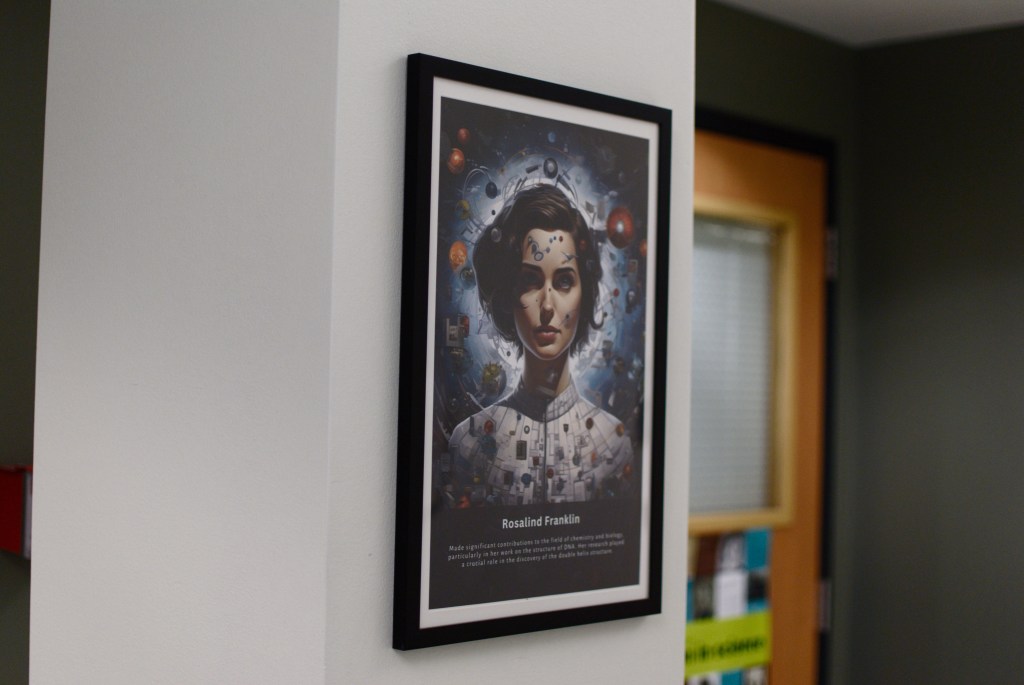
An Artificial Intelligence (A.I.) portrait of British Scientist Rosalind Franklin hangs in a hallway of the Science Building. This portrait is just one from a set of dozens of A.I. portraits of scientists bought on Etsy and hung in multiple buildings on campus.
By: Ashley Vanderhoff, Editor-in-Chief
Photos By: Jacob Pacheco, photography executive
Waubonsee Community College spans four campuses and many buildings. In its various halls, it is common to come across decorative art—often created by students. Recently, while waiting for my biology lab, a series of portraits displayed in the Science Building at the Sugar Grove Campus caught my eye. Initially, I was intrigued as I viewed the vibrant colors, the depictions of scientists and the accompanying information blurbs—a quick and simple way to learn something new while in between classes. But as I walked through the hallway, something felt off about the portraits. I began to notice their uncanny uniformity in style, inconsistent fonts and unusual mistakes that would seem strange for an artist to overlook—balled-up fists and backgrounds merging unnaturally with faces. These works were clearly not created by human artists but instead by generative artificial intelligence (A.I.).
The portraits, hung right before the Fall 2024 semester, were found by Life Science Lab Coordinator Cidney Smith through a seller on Etsy.
“I was pretty fortunate to find a seller actually on Etsy that was making these. Now they are A.I.-created, I’ve come to find out,” Cidney Smith said. “However, I think it looks cool because they have this superhero [look], compared to when you see pictures of scientists; sometimes it’s black and white. This is boring, and science is not boring at all. To me, a lot of these scientists are superheroes, so it’s great that they’re being portrayed, and they’re surrounded in the background of what they actually specialize in a lot of times too.”
Cidney Smith hopes to expand the collection of portraits, which hang through the Sugar Grove Campus Science and Weigel Buildings. She enjoys listening to students’ opinions about the artwork, and explained how some students pointed out certain mistakes throughout the series that indicated they were A.I.
“All the ones that we have are currently hanging up. We have a couple that aren’t hanging up, but they’re the ones with the extra fingertips,” Cidney Smith said. “But I do want to get more to make it more cohesive and stay on trend with what we’re studying, or if students during a certain month are focusing on something in a certain class, I’d love to have the scientists.”
In her office, located among the various supplies for the science labs at Waubonsee, she was kind enough to offer a room tour. I explored the shelves of test tubes, beakers, incubators and pipettes. It was clear she was passionate about her work, and she began her account of purchasing the art with her desire to modernize and enhance student spaces. She clarified she did not realize the portraits were A.I. when purchasing them—an understandable mistake for someone who is not an artist—and when asked whether it concerned her when she found out the art was created using A.I., she shared her perspective.
“A.I. is here,” Cidney Smith said. “I think an art student was one of the people that pointed out that it was A.I. generated, which I didn’t realize. I just thought it was a digital artist.”
A.I. is indeed here. We see it in commercials, marketing campaigns and every time we open up Google and navigate to the search bar. Does this mean we should embrace it as a new tool or even substitute it for artists? Waubonsee art students and professors of the arts and the humanities shared a variety of opinions.
Associate Professor of Humanities Dr. Aaron Lawler explained that while engines that create generative A.I. art could be useful for allowing people to create, explore and express themselves, they have their drawbacks. The data to help create the visuals is often mined from existing artists, leaving them without credit. People have to filter the images A.I. learns from, resulting in a labor force often made up of people from third-world countries who are seeing the worst of humanity day after day. It also takes away jobs and opportunities for people.
“There’s an old adage that comes out of philosophy that says you can use a knife, but you can use it for good, or you can use it for evil. I can teach you how to use a knife, give you the skills and then you can use it now to do wonderful things,” Lawler said. “You could be a surgeon and cure diseases. You could carve wonderful statues. You could be a chef and make beautiful meals. Or, if I don’t give you the right skills, you could go do horrible things, like murder someone or hurt someone with it. I think all of A.I., not just art, is that kind of tool.”
Cidney Smith did not reach out to the art department before pursuing other options, but when asked about potential collaboration with the art department, Smith was clear that she would appreciate the opportunity.
“That’s one of the things I would love to eventually work with our art department and see if they have an art club or students that are digital artists to see if they can make more for me so I could feature more student work,” Cidney Smith said. “That is a goal of mine, to do that. In the meantime, it was just like, let’s get some of these out here, and they look great, and I’m trying to make our display cases more modernized for students as well right now.”
The sciences and the arts are often seen as opposing forces, and when thinking of both, collaboration may not immediately come to mind. It’s disheartening still that an institution like Waubonsee, which fosters and encourages collaboration through its diverse programs and vibrant student life, could miss an opportunity for its art students to work on their skills and portfolios. It was further worrisome that this seemed to be a trend that extended beyond community colleges, potentially affecting the arts and other fields at large. Art and Design Club President Chelsea Smith expressed her concern about the potential opportunities being taken away from artists.
“I personally see A.I. more as a threat right now. I’m majoring in graphic design, and I see that a lot of the programs that we’re using within the design community are developing these generative AI-like tools, and it disheartens me,” Chelsea Smith said. “It takes up basically the point of design and does it for you, rather than you using your creative flow for [it], and I can, unfortunately, see it taking people’s jobs, especially with big corporations.”
Throughout history, artists have adapted to new methods of creation — continuously finding new ways to simplify the art process. This trend spans centuries, from the emergence of pre-mixed paints, which enraged the traditional painters of the 19th century, to the invention of the camera, which artists at the time believed would surely eradicate realism. Still, I think a distinction should be drawn between historical trends and the current advent of A.I. To me, the difference lies in the excess of choices an artist is still making when utilizing pre-mixed paint or a camera. Chelsea Smith noted the distinction between past inventions in the art world and generative A.I.
“I think the difference, for example, between photography and AI is that with photography, you are the one that’s clicking the button. You are the one setting up that view, making sure that your lights are right and that everything is good. In a sense, the camera is just a tool. However, I think generative AI is more than a tool. It’s just a do-it-for-you,” Chelsea Smith said. “Photography is taking the picture, and later you’re going to edit it; you’re going to use it for storyboarding. You’re going to use it for all these different things. But with A.I., it’s just creating it right there, and you’re done.”
Art, a notoriously difficult concept to define, has continually evolved in how we create, view and appreciate it. In today’s world, the advent of generative A.I. reignites a timeless question: What is art, and who has the ability to create it?
In the spring of 1917, Marcel Duchamp purchased a porcelain urinal from a store and, with a bold twist, presented it as art by notoriously submitting it to an unjuried exhibition held by the Society of Independent Artists in New York. The French painter and sculptor’s decision upended the art world, sparking a fierce debate that art could be anything if chosen by the artist and labeled as such. I asked Instructor of Art Debra Kayes if there was truly a difference between utilizing engines to create A.I. art and Duchamp’s urinal—after all, both could be considered ready-made, where an artist selects an existing object to act as art.
“I think because he actually did it, he came up with the idea, and then he had to defend it. I feel like there’s a lot in that. I think a lot of art is putting it out there,” Kayes said. “You can have a piece of soap and have some hair on it, and it could be art, but if you were Tom Friedman, then you would do a bunch of those, and then you’d say this is art, so I think it’s all about your intention. And with A.I. generation, what is its intention?”
While the trend of allowing for a more efficient art process is not inherently bad, purely generated A.I. seems to be eradicating the choices an artist must make—eradicating the art process. A tool that increases efficiency is not always the right path, especially if it causes us to desert the choices that give our work passion and uniqueness. Lawler also noted the trend towards the easier and the more efficient across various fields.
“I think we’re already seeing this with how many people nowadays are looking for the shortest path, not the best path, but the shortest path. I’m sure you’ve experienced this, where people say to you, ‘If you take these classes, you’ll take longer to get out of college, and you won’t get into your career fast enough, right?’ It’s this constant push to shorten things,” Lawler said. “I love Waubonsee, but we offer the QuickPath program, and I’m always torn by it, because, sure, we can get through the classes faster, but is faster better? I don’t know. And there are just dying arts, where people don’t know how to do things that we used to know how to do very well, and that’s a loss. That’s a loss of knowledge. That’s a loss of what it means to be human.”
But I would argue that generative A.I. platforms were not created as tools for artists; their inherent, widespread appeal is that we get much more out of these algorithms than we have to put into them. Kayes noted that the widespread appeal of these engines often stems from trying to save time.
“I think a lot of people [use A.I.] to save energy or to save time. The funny thing is, where does that time go? Does it go to the end of your life? I think about that even when I’m doing keyboard shortcuts. If I’m in Illustrator, the amount of time that I saved to take my mouse up from here to here, versus me just pressing the key—I just saved myself 30 milliseconds. I get to strap that on to the end of my life,” Kayes said. “So, I mean, I think people do it out of laziness, and maybe they’re not feeling super creative too, and so they’re using it to help with that.”
Lawler is one of numerous professors who have considered utilizing A.I. in the classroom. In the past, Lawler has utilized a program created by Peter Blaškovič, an academic who believed that with the right tool, anyone could be an artist. The program allows users to create abstract-style paintings by creating patterns when dragging a mouse or finger across the screen. However, with the rise of generative A.I., even programs like Blaškovič’s seem to be becoming obsolete.
“[The program] has this really therapeutic effect, and it can be very beautiful. You can create really cool things, and so people who never would call themselves artists would try this, and they would feel really good about it,” Lawler said. “I used to actually assign to make one of these, but now there’s no point. Because why would you go do this when you could just go to the A.I. thing and write?”
Should everyone have a right to be an artist? Blaškovič’s experiment serves as an excellent example of exploring the balance between maintaining and losing control of our own art. While it’s understandable why some would defend that everyone should have the necessary tools to feel like an artist, the dedication of an artist to their craft, and the dedication of people from all professions attests to why we shouldn’t allow art to be all inspiration and no exertion. If we aren’t willing to put in the time to learn how to create art; if we don’t have that time, we can still view and appreciate it. Because, as unfortunate as it is, it is difficult to maintain that plugging a prompt into an engine deserves the accreditation of an artist. Still, it is complicated when we consider the vast amount of things we have deemed art throughout time. Lawler shared his thoughts about what it means to be an artist.
“Sometimes, when using A.I., what you’re good at is coming up with a bunch of words like red, swirl, spin. I think anybody could do that, right? I don’t know, but this has often been the argument for it. I don’t personally like the Jackson Pollocks, where it’s like splatter paintings. But people have said, ‘Well, anybody could do that.’ Anybody can make those paintings. Doesn’t take any skill,” Lawler said.
The debate surrounding generative A.I. is vast and complicated. However, when viewed through a more narrow lens—specifically at a community college like Waubonsee, where student collaboration and opportunities are often encouraged—the complicity becomes less so. Ultimately, the only opinions that should matter are those of the communities, and we have to ensure we are not taking away opportunities for our students. Decorative art throughout Waubonsee should be one of those areas where we strive for collaboration over cursory approaches.
“I would have loved to see Waubonsee, or whoever was in charge of that, putting those posters up to contact the art department. We have a whole Art and Design club. We are begging to do projects. We have so many art classes that could have been used as maybe an assignment. Teachers could have been like, ‘Hey, we’re designing these posters around campus; submit your ideas,’ and then it could have been judged by whoever wants to put them up, and it would have created more of a community on campus,” Chelsea Smith said. “If someone’s work got chosen, that person could feel great. They could put that on their resume. They could build more confidence when it comes to their art, knowing that something that they created is on display and it’s in different parts of Waubonsee.”
Kayes agreed that the art department could have collaborated on this project.
“We have an art department here; it could be a project, or we could collaborate. We’re always willing… We are talking about portfolios all the time because it really is a way to get a job. So, if [students] wanted to finish here with their two-year degree, and if they had a really good portfolio, they could get into a nice internship or a junior graphic design position with a good portfolio,” Kayes said.
One of the preferences Life Science Lab Coordinator Smith expressed was that the portraits had a uniform look to them; however, this would have been not only an easy task for art students but also a potentially beneficial and realistic career experience.
“Artists create their own themes. They have their own styles. More often than not, we will basically create a collection, and in that collection, it has a similar style, and it’s uniform, and it’s all cohesive. So, I don’t think that would have been a problem at all. People do that already in the art world as a career; it wouldn’t be hard for us to do that at all,” Chelsea Smith said.
Additionally, Chelsea Smith expressed how art students could have potentially fixed many of the errors currently present in the work.
“I took a design class, and we learned the seven principles of design. One of them is balance. So if your [work] isn’t balanced, it’s not really cohesive. That’s one thing that all artists really focus on. We don’t think through these seven principles and make sure our artwork has that. It’s just a subconscious thing where we can feel it,” Smith said. “I can’t speak for everybody, but I feel it when it’s unbalanced or when the contrast is off, or whatever is going on that would have been easily fixed, especially with the wording, too. We have a typography class that I’m currently in right now. It literally is teaching you how to do formatting and balance this with words and our designs combined.”
It would be unfair to attempt to criticize all use of generative A.I. in an academic setting—it has both its drawbacks and opportunities. Associate Professor of Biology Justin Hoshaw has extensively researched the benefits A.I. can offer in the classroom for both faculty and students.
“The reason that I am such an advocate for Timely Grader and trying to pilot it here is because Timely Grader seems to integrate the best with Canvas and just makes that process pretty seamless for both students and faculty,” Hoshaw said. “I think there’s a lot of benefits of the AI feedback between getting feedback much sooner. Instead of some students waiting weeks or months for feedback when faculty get bogged down with papers, this is getting feedback to students right away. This is also providing more detailed feedback every time there’s an issue and provides unbiased feedback.”
Timely Grader is an A.I.-powered platform that follows educator’s guidelines. Faculty can go in and change or revise any feedback the program makes. Hoshaw has also provided his students with prompts for them to plug into A.I. programs like ChatGPT that can enhance the studying experience. The prompts include asking for feedback on answers to study guides and breaking down complex topics that a student might be confused about step by step. Areas like these could transform the student experience, allowing immediate feedback, efficient learning, and support to students who might be hesitant to ask their professors questions in person.
As our technology continues to advance, however, it is important to keep certain learning tendencies in mind so that we do not forget them. Lawler discussed the beauty of some of the traditional ways of consuming information.
“When we go to Google and type in a search, we only get what we’re looking for. There’s no chance to stumble upon something random, right? But if you go into a library to search for a book, you have all kinds of chances to stumble into a book you weren’t looking for. And it might be the best book in the world, so you’re always building on what you only know,” Lawler said. “And here’s the really dark part of that: you could only ask questions about things that you know a little bit about, right? You have to know something to ask the question. But if you just randomly walk into a library, you could stumble into a book and then ask a question you never were going to ask before because it was random. It was chaotic.”
In a world of ever-evolving technology and human innovation, we allow our curiosity to carry us forward. Throughout history, we have traversed across deserts, seas and mountains to form civilizations and empires. We have developed thousands of tools across various fields, including in the arts. Our scientific advancements have evolved from the Bronze Age in Egypt and Mesopotamia, where innovations like irrigation systems transformed agriculture, to the present day, where we have ventured beyond our own planet to explore others through space travel. Science has grown immensely, and with it, our time for leisure. I would argue, however, if we allow art to be all inspiration and no exertion, we are losing what it was meant for in the first place. A.I. is here; it certainly won’t be leaving, but that doesn’t mean we should let ourselves be swept away by the cheaper, quicker and easier. We should not let ourselves forget the beauty of creating and viewing art as uniquely human.
Purchasing A.I. art was a missed opportunity for students at Waubonsee to work on their portfolios, gain real-world experience, and collaborate with other departments. It can often be easiest to devote ourselves to the efficiency of A.I. and to cast aside hard work. But if we do that, we risk casting aside human passion—even our humanity. Through collaboration, we refuse to allow A.I.’s advanced algorithms to only serve to empower the evolved laziness and newfound impatience of people.
 Waubonsee Weekly
Leave a comment