

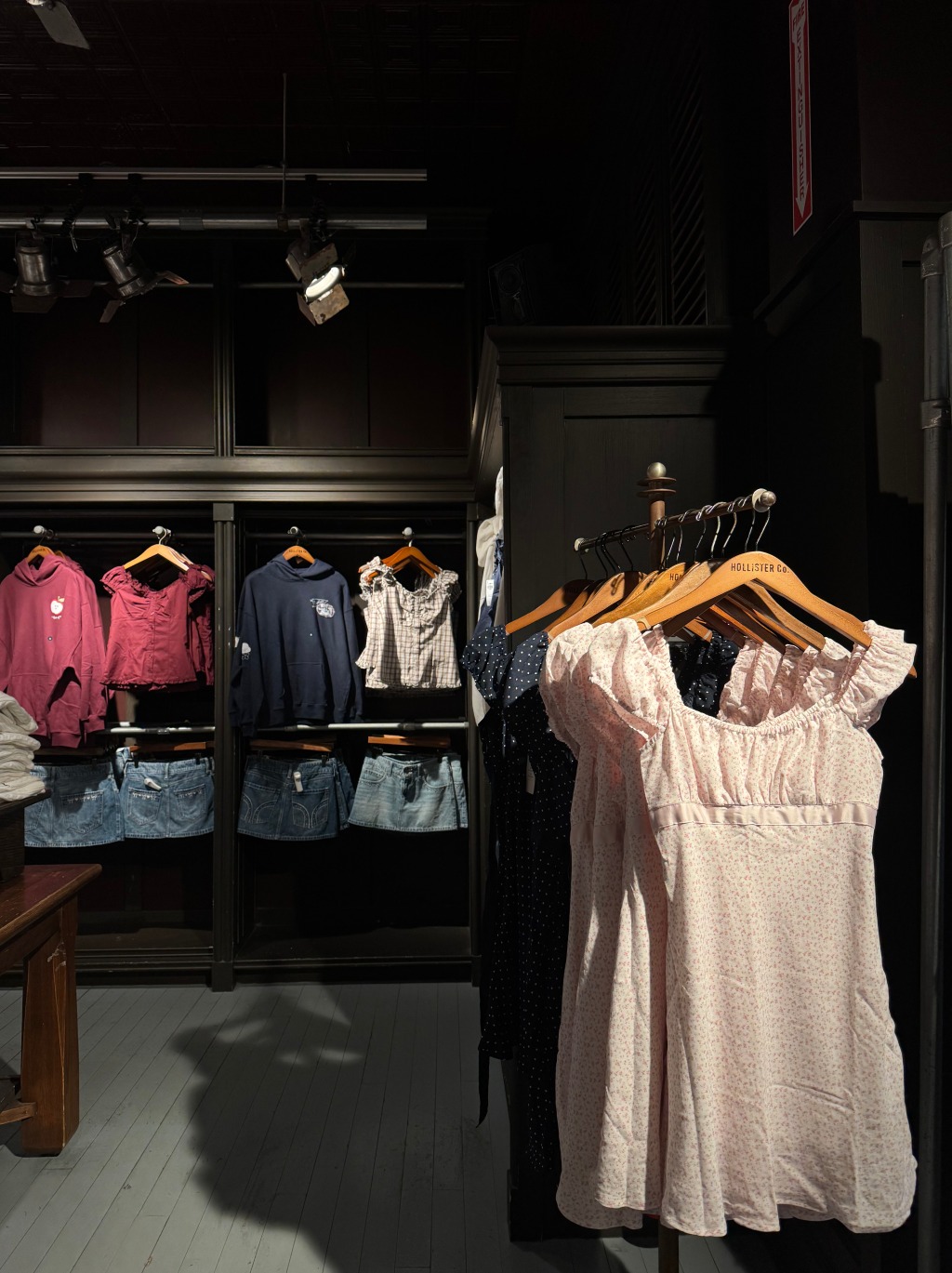
Retail store Hollister showcasing trending dresses and blouses that have floral and plaid patterns on light, softer colors in their store. Popular styles such as “trad-wife” or “cottagecore” romanticize domestic, traditional lifestyles through pastel colors and modest, vintage designs.
By: Kisella Valignota, Communications Director
As tensions continue to rise in American politics, the reactions and beliefs of the public can be seen beyond advocacy or demonstrations, but rather reflected through one of the most accessible mediums of art and self-expression: fashion. What people wear and how certain styles become popular is a reflection of what is happening in society. From these fashion outlets, people may entertain or engage with specific aesthetics that are affiliated with political beliefs, perpetuating certain agendas without recognizing it.
Just as any craft or art form does, fashion has always reflected the social, political and historical climate of its making. Assistant Professor of Art Heather Weber teaches courses such as Art History and Art Appreciation, which details the dynamic relationship between artistry and its historical context.
“‘Art imitates life’ or so they say. People are influenced by what is going on around them,” said Weber.
As conservatism has risen in the past decade, there have been different ways that the ideology has gone beyond affecting people’s political beliefs, and further pushed into trends and style choices. During the 2024 presidential election season, NBC News reporter Yasmin Vossoughian addressed how certain aesthetics and fashion trends surged in popularity, alongside President Donald Trump’s reelection campaign.
“Influencers representing the “trad-wife,” (short for traditional wife) and old money aesthetic are gaining popularity online. It’s happening against the backdrop of an election that’s sending President-elect Donald Trump to a second term, with at least some voters seeming to embrace the so-called traditional family values that Trump and other conservatives have tried to tap into,” Vossoughian said. “Donald Trump’s whole sales pitch was very much about a return to the past, a return to the time when people felt more secure in their social roles, ‘Make America Great Again.’ It’s right there in the name.”
With landmark legislation changing, such as the U.S. Supreme Court’s overturning of Roe v. Wade in 2022 or their current temporary ruling that allows ICE agents to racially profile individuals, that indicate shifts in the political climate, Americans have seen a regressive trajectory that many representatives in the government are moving towards. In the fashion world, it appears that some seem to entertain this idea beyond political ideology and through the style labeled trad-wife.
Along with the emergence of many influencers romanticizing their own trad-wife lifestyle, women seem to be drawn to the aesthetic appeal of traditional femininity and domesticity. Visuals may include vintage clothing made from soft materials, pastel colors or prairie-style patterns. All of this is oftentimes accompanied by the woman doing homemaker duties such as cooking or cleaning the house alone, or even verbally expressing how their responsibilities stem from their voluntary submission to their husband emotionally, physically or financially.
“Not everyone who drives these trends are necessarily political…but [they] offer romanticized versions of domestic life and style that draw huge numbers of eyes,” Vossoughian said.
Whether the appeal of traditional domesticity is based on personal lifestyle preferences or the alluring aesthetics of it, the reality behind these roles is a lack of freedom and independence that women have historically fought for. This dependence on their partners has led to cases of abuse or violence as they are put in powerless positions. In The Guardian’s article, “Sundresses and rugged self-sufficiency: ‘tradwives’ tout a conservative American past … that didn’t exist,” reporter Carter Sherman describes the different forms of oppression women faced during the time of the original trad-wives.
“The women of the 19th century and 1950s also lived without the right to birth control or, after they were invented, credit cards…Domestic violence was not taken seriously. Rape victims’ sexual history could be brought up in trials, while marital rape was not even a crime,” said Sherman.
When it comes to these influencers and how their audience perceives them, the problem is not only that they feed into the patriarchy and the oppression of women, but how they try to sell their beliefs through the aesthetic. From alluring colors to vintage patterns, the trend allows for the fostering and glorification of ideas that go beyond a trad-wife’s clothing choices; beliefs that flourish under a conservative political climate which advocates for strict gender roles.
Not only can entertaining these conservative-inspired aesthetics be detrimental to women, but they also romanticize an inaccessible lifestyle for many. Staying at home and being a trad-wife to a nuclear family is not only rooted in traditional values from the past, but a practice from an economy does not reflect modern times. Sherman details that the trad-wife’s significant background is inherently flawed.
“The 1950s, another conservative inspiration, were also shaped by government subsidies for housing and education – as well as a post-second world war movement to pressure women out of the workforce – that briefly made it economically possible for vast numbers of white American women to live as housewives,” Sherman said.
Sherman also adds how these economic benefits provided to white American women were not as accessible to people of color, acknowledging the intersectional struggles that women of color faced during these glorified times. These interwoven degrees of oppression for women of color is not only reflected in this aesthetic, but also something that has been noticed when addressing other conservative-based fashion trends.
Labels and phrases such as “old money” or “quiet luxury” have caught the attention of many, promoting modest, corporate, logoless and minimalistic attire as the latest fad. These trending luxurious aesthetics have especially popularized in the West and serve to make it seem that we are financially stable as an individual and a nation – still appearing timeless and chic within current societies, regardless of whether the economies are similarly thriving.
These looks may just be offering a professional, elegant appearance and are another wave of fashion trends. However, some have questioned the hyperfixation around the Western’s embrace to the style while those same groups frown upon modest fashion in Muslim communities. In the Vogue Business article “Why is conservative dressing on the rise when modest fashion is under fire?” reporter Maliha Shoaib acknowledges the glorification of white quiet luxury compared to styles most Muslim women engage with.
“Trend analysts have been quick to point out that the rise in quiet luxury can be traced back to a desire for tradition and conservative ideals in the face of the growing uncertainty of the post-Covid world. So while quiet luxury styles may be more inclusive to modest fashion wearers on the surface, the same conservative ideals that are spurring this trend are creating political tensions and growing Islamophobia that make it harder to present as visibly Muslim,” Shoaib said.
In response, different fashion brands and designers have found ways to compromise to their targeted audience. Regardless, their reparative actions do not negate the harm of the double standard, nor the dangerous rhetoric and beliefs coming from the current political environment.
Although there is an obvious appeal to wearing – or the appearance of wearing – high-quality clothes, the timeless, preppy look is directly tied to traditional values; whether it be through the gender roles implied with dressing modestly, or the generational wealth that constructs the label old money.
This concept of inherited wealth, class and reputation within generations of a family is rooted in exclusivity and long-standing hierarchies; it is socially conservative in nature. Under an administration that asks for the return to traditional systems and roles, the popularity of these aesthetics grows more and more. Vogue Business reporter Madeline Schulz writes in her article, “How the conservative era will change beauty standards,” about the way these fashion labels can address intersectional struggles of class and race, offering more than just an aesthetic visual.
“Old money implies generational wealth — something non-white Americans have historically been prohibited from amassing. It’s moving more into the mainstream as well…The swapping of bodycons and cutouts for blazers, maxi skirts and lots of beige signals an embrace of the more buttoned-up aesthetics so tightly bound up with a more conservative look,” said Schulz.
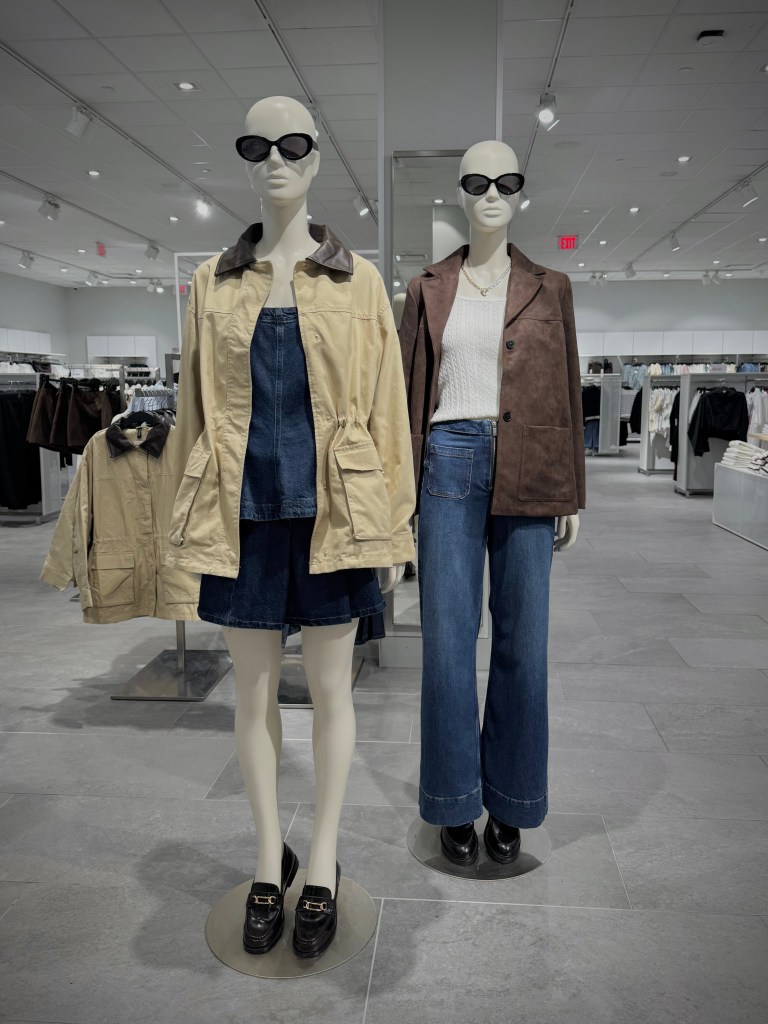
Fashion retailer H&M displays popular jackets, denim-wear, sweaters and shoes on two mannequins. Quiet luxury is a trending aesthetic that’s based off of logo-less, tailored and modest clothing style; typically attempting to resemble luxury brands.
Being wealthy isn’t inherently bad, but the perpetuation of the beliefs associated with its aesthetic are. Harmful ideals foster when old money is primarily associated with White people in elitist spaces and quiet luxury looks down on new money, a socioeconomic status typically affiliated with people of color or individuals with backgrounds of lower-class. The emphasis on generational wealth and comparison to new money, where the latter is observed as beneath the former, extends racist and classist undertones.
Some find that embodying this aesthetic comes from a place of fears for the American economy, and comfort in the appearance of financial stability. When these looks offer the illusion of higher social status within a poor economy, the established social standards allow for people to still appear wealthy in desperate times.
“Fashion reflects, in a sense, our deepest and sometimes inarticulate aspirations and ideals and connections with communities. But, nearly a quarter of Americans are living paycheck to paycheck. Wanting to look like old money doesn’t always equate to having it; because they’re anxious about the future, they take refuge in an imagined past,” said Vossoughian.
Whether you’re in agreement with the conservative beliefs affiliated with these rising aesthetics or not, sporting them perpetuates many political stances circulating American media right now. It’s important to not only stay informed, but be aware of what you may be promoting through your actions.
“As with the understanding of history in general, it takes time [to be aware of the relationship between art and the social climate]. It is difficult to view the entire picture when you are standing in the middle of it,” said Weber. “I think it is everyone’s responsibility to be aware of and engaged with what is going on around them.”
 Waubonsee Weekly
Leave a comment