

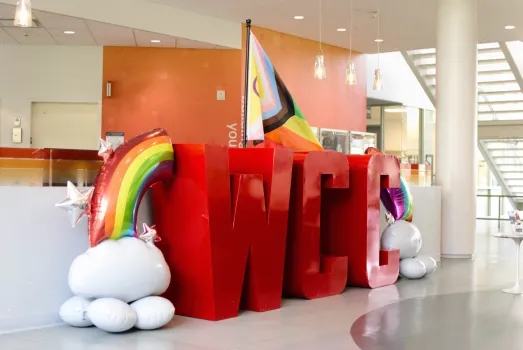
A colorful pride display brightens the Waubonsee Community College’s campus to celebrate the start of LGBTQ+ History Month. The display resides in the student center, featuring the pride progress flag and rainbow balloons.
By: Nicky Mondia, Reporter
From worldwide rainbow-washed marketing campaigns to a seemingly “new queer slang” adopted and discarded by the masses every two weeks, it is hard to reflect on this quarter of the 21st century without centralizing queerness as its defining aesthetic. How have the language and fashion of a once marginalized group been repackaged and sold as novelty? Has identity itself been reduced to a costume? Queerness has gone from a cultural taboo to a worldwide phenomenon with Gen Z as the primary consumer, raising the question: is this shift genuine appreciation of a once-hidden culture or harmful appropriation that misrepresents a community built on resilience?
The marketability of queerness has fluctuated with its social acceptance. As early as the 1980s, companies began to recognize the untapped potential of pandering to a queer audience. Most famously, Subaru was the pioneer of adding small nods designed to appeal to queer consumers. Using taglines and license plates with double meanings as a show of subtle public allyship, including a license plate that read “XENA LVR” accompanied by the tagline “Get out, and stay out,” a wink to the predominantly lesbian fan base of Xena: Warrior Princess, a 1995 action television series starring Lucy Lawless as Xena and Renée O’Connor as Gabrielle, Xena’s companion and lover. This ad was a major success for the company. While queer historians reflect on Subaru’s corporate allyship with fondness, it showed the world that queer audiences were profitable, attracting attention from other corporations, well-intentioned or not.
The major success of Subaru’s ad set the stage for the development of rainbow capitalism in the 2000s, in which companies exploit queerness by releasing thoughtless or stereotypical Pride merchandise to appear supportive while chasing profit. Think of Xbox changing their profile picture to being a rainbow logo for Pride month or Target releasing shirts that just say “Fierce” across them in rainbow lettering. These are examples of companies’ lackluster corporate allyship that are often dismissed as disingenuous across the political spectrum. We are now seeing the long-standing effects of this through Gen Z. The trend has evolved past merchandise but now is directly influencing language, fashion and social media aesthetics, shaping the way Gen Z perceives and interacts with queerness.
Consider slang. Phrases like “slay,” “tea” and “shade” began in Black queer spaces but are now mainstream. More recently, “clock it” went viral on TikTok, often performed by tapping thumb to index finger, though in the ballroom scene where it originated, the gesture is thumb to middle finger. A small deviation, but one that reveals the larger issue: the erasure of context. What was once coded language of resilience is now rebranded as disposable internet catchphrases.
Ballroom culture makes this clear. As defined by Vancouver-based nonprofit Van Vogue Jam, ballroom is “an underground queer subculture, founded by Black trans and queer folks, in which people walk, perform, dance, lip-sync, and model in categories designed to simultaneously epitomize and satirize gender constructs.” In its time, Ballroom offered sanctuary when being queer was punishable by law. That history is what makes its preservation urgent. When non-queer people adopt its language or symbols without context, the result often feels dismissive, even exploitative. The continued use of culturally significant lingo, like all forms of cultural appropriation, removes or distorts important elements of what made the culture distinct in the first place. Stripping it of its context and individuality.
Fashion tells a similar story. Gen Z has blurred what queerness looks like, embracing painted nails, pearl necklaces and carabiner styles once used by queer people to signal identity. TikTok amplified this trend, particularly among men experimenting with traditionally feminine accessories. On one hand, this is liberating: queer aesthetics are dismantling harmful gender binaries and encouraging individuality. On the other hand, for decades, a simple earring in the “wrong” ear, a handkerchief in a back pocket or a rainbow pin could make someone a target of hate speech, harassment or worse. These subtle fashion statements carried real danger, but they also offered connection, a coded way to find community in a hostile world. As the concept of gender evolves, we are watching the cultural shift queer people fought for. While it can be perceived as performative, the tolerance and acceptance of what men and women are supposed to wear has come a long way, and fighting against it to preserve what queerness once looked like is more reductive than looking towards the future of what queerness is. These challenges are an opportunity to honor the past while embracing a future where queerness is not just survival but style without fear.
So is Gen Z’s embrace of queer aesthetics trivializing queerness itself? Too often, yes. Viral phrases are used without regard for origin. Symbols that once carried weight are now aesthetic choices. If this were any other culture, cries of appropriation would be louder. But when it comes to queerness, it’s a culture wildly founded by Black trans and queer communities. There is a severe lack of awareness or regard, while it is no secret Western culture has no issue with stealing from marginalized groups. Even in the process of writing this article, I have regularly encountered pushback from others on the importance of this article. With some people telling me the topic of appropriation is “not that deep,” the dismissal itself reveals the deeper forces at work: racism and homophobia, still shaping how queerness is consumed, remembered, and represented.
Instructor of Sociology Jessie Miller is a professor at Waubonsee and one of the faculty advisors for the PRIDE club, which aims to give queer students at Waubonsee a safe space and advocate on behalf of the queer student body. Miller shared their view on why queerness is often cast aside.
“In the US, we don’t teach people how to think systemically… It goes back to not knowing that history. When we forget those historical roots. Then again, we’re really ignoring that history and not acknowledging the deeper history there,” Miller said.
When asked whether Gen Z’s redefinition of queerness was for the better or worse, Miller resisted the binary, instead reflecting on the cultural shift they’ve witnessed.
“I don’t think it’s either/or… In the US, especially in Western culture, we want to fit things into neat boxes and categories,” Miller said. “It’s just so different… I kind of love that Gen Z doesn’t feel the need to come out and just lives as they are… I think it’s a spectrum; I don’t think there is an easy answer to if that change is flattening the queer experience or not.”
Miller’s reminder is important. It’s not just flattening; it’s freedom as well as an ever-changing kaleidoscope of a personal identity.
While two things can be true at once, we can acknowledge this progress without forgetting what came before it; queerness has always been more than a costume. It is a history of survival, of coded language and symbols that carried real risk, of communities created by Black and trans people who refused to disappear. To dismiss appropriation as “not that deep” is to ignore the racism and homophobia still shaping how queerness is consumed. As Miller put it, “It’s a spectrum.” The future of queerness is a forever-changing landscape, but as long as we remember that what now feels effortless was once an act of defiance. The cultural roots will always remain.
 Waubonsee Weekly
Leave a comment