

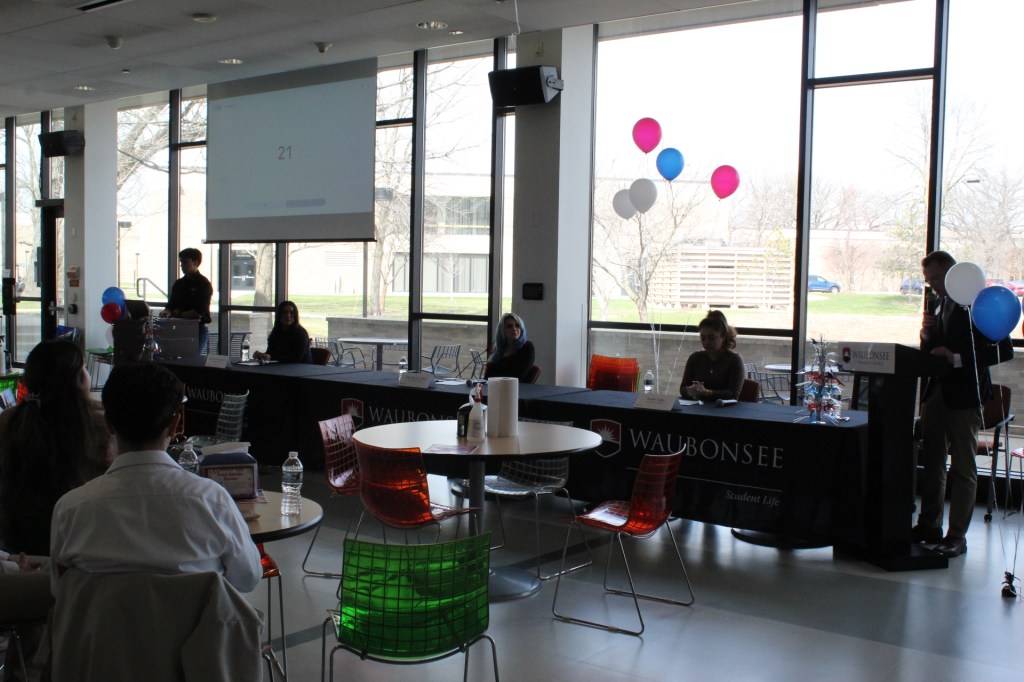
Student Senate president candidates Angela Bolanos Carbajal, Trish Lewis and Bianka Valdez await their first question during “The Debate” at Waubonsee Community College’s Sugar Grove Campus on March 25. The event gave students a chance to hear directly from candidates ahead of the upcoming student government elections.
By: Johnny Crouch, Co-Editor-In-Chief | Photos By: Johnny Crouch
On Wednesday, March 25, the Student Senate hosted “The Debate” at Waubonsee Community College’s Sugar Grove Campus in the Student Center Café from 1 to 3 p.m., bringing together candidates for student senate president, student trustee and student senator ahead of the upcoming election.
Moderated by Student Senator Connor Anderson alongside Student Senate Vice President Ennis Ballines, the event allowed candidates to present their platforms through opening statements, prepared “softball” questions, unreleased “curveball” questions and a rebuttal period. Students in attendance also had the opportunity to ask questions during an open forum at the conclusion of the debate.
The debate began with candidates for student senate president: Angela Bolanos Carbajal, Trish Lewis and Bianka Valdez.
Each candidate opened with a one-minute statement outlining their goals, followed by questions centered on student issues, engagement and advocacy.
Angela Bolanos Carbajal, a current student senator, emphasized building upon the senate’s progress, saying the group has “laid the foundation” and that she hopes to expand resources and increase transparency. She identified lack of awareness as a key issue for students, pointing to limited knowledge of scholarships and opportunities.
Lewis focused on accessibility and community, advocating for expanded mental health support, transportation and the reopening of the Sugar Grove daycare. She described her goal as “putting the community in community college.”
Valdez highlighted the need for stronger student representation, emphasizing the importance of addressing everyday challenges such as balancing work, classes and mental health. She also pointed to resource accessibility and career readiness as major concerns.
Across multiple questions, all three candidates returned to themes of visibility and engagement. Suggestions included increased tabling efforts, where students set up tables around campus to share information and connect with others, along with stronger social media presence, collaboration with student organizations and creating a dedicated student government space.
When asked about advocacy, Bolanos Carbajal described it as “listening, taking action and following up,” while Lewis emphasized reflection of the entire student body and Valdez stressed speaking up “even when it’s an unpopular opinion.”
The candidates also proposed initiatives such as expanding the campus pantry, creating a campus closet, improving communication and increasing student involvement through events and outreach.
Following a brief intermission, the debate shifted to student trustee candidates Daniela Alfano, Daniel Cadena and Milton Mondragon.
Alfano, a first-generation student, emphasized the importance of direct student feedback, proposing regular surveys to communicate concerns to the board of trustees. She identified financial stress, mental health and time management as key challenges facing students.
Cadena, a political science major, also pointed to financial insecurity as a primary issue and expressed support for initiatives such as a campus closet and expanded childcare services.
Mondragon, who noted his experience balancing work and school, focused on representing students with similar responsibilities and advocated for expanded mental health resources and transportation options. After starting the debate with a strained voice, he ultimately stepped away as speaking became increasingly difficult.
Candidates were also asked about Waubonsee’s RISE 2030 strategic plan, where responses centered on supporting the “whole student” through resources, career opportunities and inclusive environments.
Time management and commitment were recurring themes as candidates explained how they would handle the responsibilities of the role. Alfano emphasized structured planning and avoiding burnout, while Cadena said he was prepared to reduce work hours if necessary.
When discussing advocacy, Alfano described it as turning student concerns into action, Cadena framed it as supporting those who cannot advocate for themselves and Mondragon emphasized balancing perspectives between students and administration.
Proposals for strengthening campus and community connections included shared events with other colleges, increased collaboration between student governments and expanded student engagement through surveys and outreach.
The final portion of the debate featured student senator candidates Brandon Finn and Tristan Reyes.
Finn, drawing on experience in business and leadership programs, identified financial barriers and lack of career preparation as major concerns. He proposed initiatives such as networking workshops, resume reviews and internship support, emphasizing the importance of early career development.
Reyes focused on communication gaps between the college and students, citing lack of awareness about services such as the campus shuttle. He proposed improving outreach and ensuring students are informed about available resources and events.
Both candidates stressed inclusivity and accessibility in their responses. Finn highlighted collaboration across clubs, while Reyes emphasized consistent outreach and student feedback through polls and direct communication.
On the topic of advocacy, Finn described leadership as prioritizing others, stating that leaders act as “a vehicle for your wishes,” while Reyes emphasized taking action to ensure ideas lead to tangible improvements.
In addressing food insecurity, Finn proposed leveraging external partnerships to expand food access, while Reyes suggested making existing resources more usable by providing basic items such as dishes and utensils.
For their primary initiatives, Finn emphasized career development through networking opportunities, while Reyes focused on improving communication and maintaining existing campus services.
Each segment of the debate concluded with a seven-minute rebuttal period, though candidates largely chose not to challenge one another, before the event wrapped up with an open forum where students asked questions about engagement, fundraising and accountability.
Throughout the event, moderators emphasized the importance of civic engagement and student participation in the election process.
“Your voice matters, your vote matters,” Anderson said in closing, encouraging students to make their voices heard at the ballot box.
With the election approaching, students now have the opportunity to shape the future of student leadership at Waubonsee. Voting will take place from March 30 to April 2 via student email.
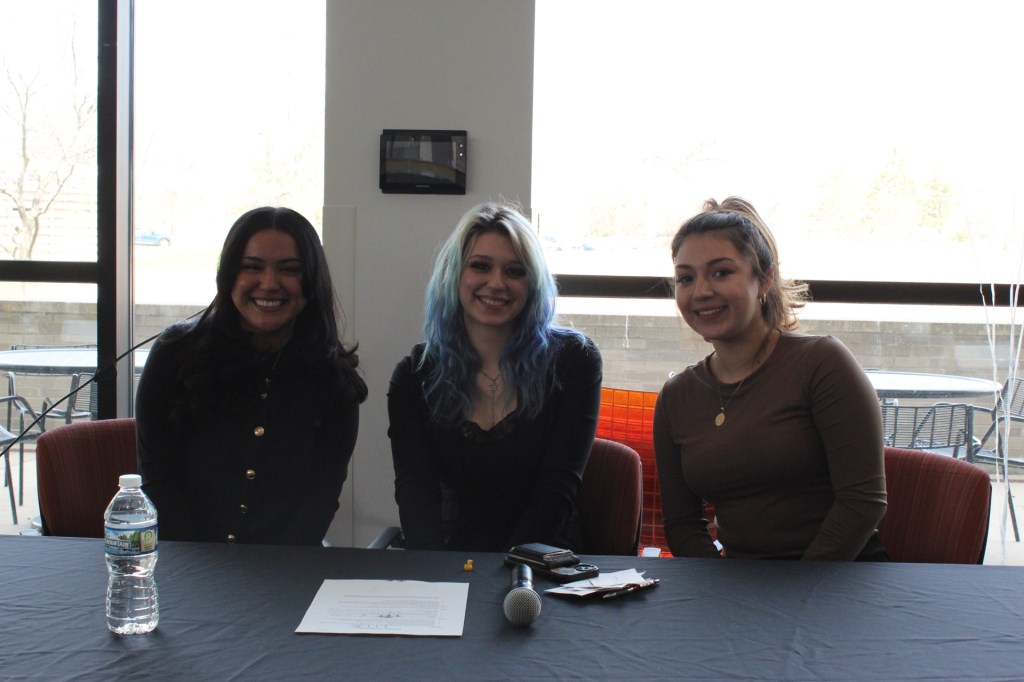
Student Senate president candidates Angela Bolanos Carbajal, Trish Lewis and Bianka Valdez pose for a photo following “The Debate.” The forum gave each candidate an opportunity to outline their priorities and connect with students before voting begins.
 Waubonsee Weekly
Leave a comment