

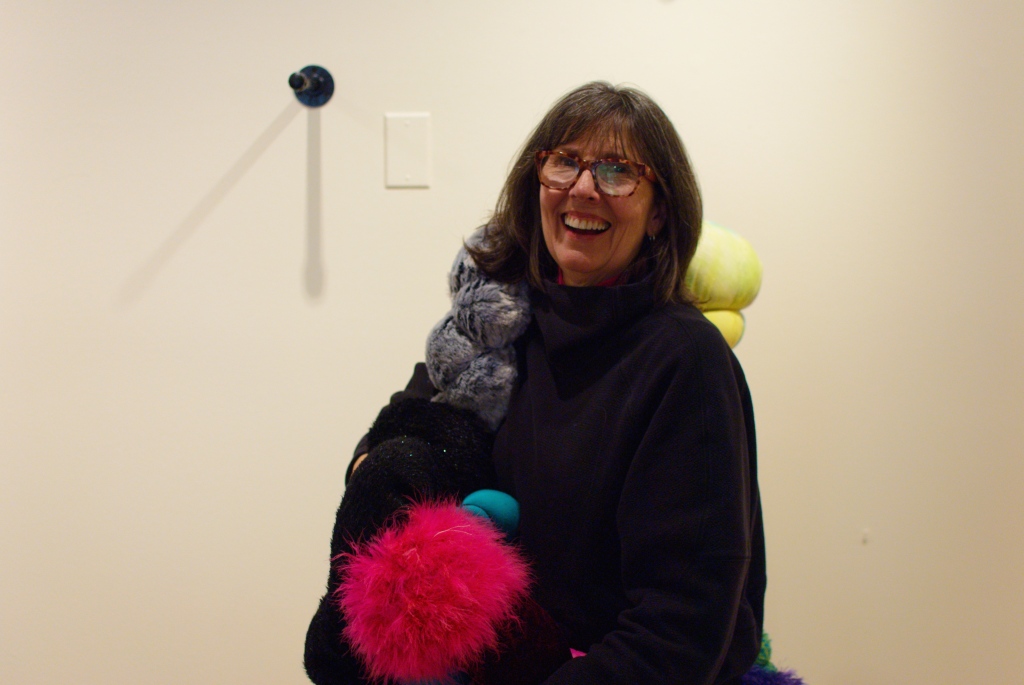
Arrowhead Gallery hosted artist Bobbi Meier for her Artist Talk, where she demonstrated how her multimedia pantyhose boas are interactive. Throughout the exhibit, Meier encourages visitors to immerse themselves in the uncomfortable through viewing, wearing, and touching her pieces.
By: Kisella Valignota, Communications Director | Photos by: Jacob Pacheco, Photography Executive
Abstract multimedia artist Bobbi Meier visited Waubonsee Community College’s Arrowhead Gallery on Thursday, Oct. 9, for an Artists Talk about her current exhibition, “We Thought We Were Comfortable”. The exhibition consists of colorful, abstract pieces that were created over the course of a few years. Although the series has developed over time, Meier found significance in the theme’s relation to both personal experiences and societal context.
“Absurd art for absurd times. The work is, in my opinion, wildly unreasonable, illogical, or inappropriate. I feel like bits and pieces of all of that fit into this work and to my work in general. [I was] thinking a lot about being comfortable and uncomfortable, and we can’t have comfort without discomfort,” Meier said.
Different parts of the exhibit were categorized depending on the style and time period, such as the recent disturbing Teddies, which were distorted and mangled stuffed animals that were reconstructed through other toys, thrifted clothing or sewing patterns. Most recently, the addition of her Violet Studies which were nostalgic, watercolor paintings of African Violets, representing the flowers that Meier grew in her personal garden in honor of her grandmother. One of the oldest installations of work from 2011-2012 and the following years prompted the start of the collection.
“I had a full time job as a teacher, and all those life things. I had kids and all that stuff, and I graduated from [my Master’s] program. I go back to work, and my dad’s diagnosed with esophageal cancer… I thought I had had all this time to make art when I was in school, but that got squelched partially because of life, but also because of my dad’s illness,” Meier said. “So if you look carefully in this work, you’ll notice that there’s medical paraphernalia embedded into it, like a cannula that’s a breathing tube or a feeding tube, or something that looks like a tumor, or, you know, those types of things. That was not intentional.”
Alongside the unintended physical attributes that reflected Meier’s feelings and experiences at the time, she also created her artwork to incorporate elements of difficult emotions, obscurity and randomness. These add-ons oftentimes lacked direct meaning, yet served to further convey the odd experience of the piece through that.
“So there’s all that kind of grief and angst and everything kind of embedded into much of this work. And then there’s this bit, like, what the heck is this? These little balls hanging down and they’re playful and they’re weird, and this is like a sleeve from a kid’s shirt. Then there’s these strange things. I’m not saying what that is. I don’t know, but it’s kind of weird. So this is the beginning of thinking about what else is going to go on in the show.”
This installation prompted the theme of the series, as well as the style that most of the collection began to follow. However, even though this piece and the ones that followed incorporated multiple mediums that especially highlighted fiber arts, Meier emphasized that although she uses it often, she did not start out making work that way.
After graduating from Northern Illinois University with a degree in Visual Communications, she primarily focused on graphic design until Meier attended the School of the Art Institute of Chicago for Fiber & Material Studies and K-12 Education. The changes in both her life and career path eventually led her to something new, where her time with graphic design and teachings of fine art merged together into this art form.
“When I became an art educator, I was mostly drawing and painting. I think my experience teaching high school [encouraged my switch in materials], where, when you teach high school art, you have to teach print making and drawing and sculpture; it was a multidisciplined practice. I wasn’t just plugged into a painting department. I was teaching something called design and materials, so ceramics and all that. So, I really feel like that experience of teaching high school students multidisciplinary work definitely influenced what I do now as a fine artist,” Meier said.
Inspired by artists such as Mike Kelly, Sara Lucas and Louise Bourgeois, Meier incorporated layers of different mediums to emphasize elements of nostalgia, age, discomfort, angst and childhood throughout the collection. The usage of a variety of textiles were especially prompted through Meier’s understanding of them as personalized experiences.
“Textiles are so personal to everybody, right? We wear them on our bodies, we sleep in them. When I went through that [Fibers & Material Arts Masters] program, I hadn’t really thought about that in that way, and I think that that’s a huge attraction for me to use this work, because it is personal for everyone in this room.”
The level of multimedia that Meier composes is complex and layered, not only through the variety that is incorporated, but also based on the specific context that the addition has based on the timeframe or who it was from. Throughout Meier’s work, she often used recycled materials such as thrifted clothes or gifts from people, with a large emphasis on her uses of pantyhose.
Many of the fiber material artworks are interactive for viewers to try on, such as the colorful deformed boas made of pantyhose deformed with sewing stitches and lumps from other clothes, as well as the non-functional purses that can be styled as a fashionable bag with no access to actual usage. Meier promoted the interaction that people have with them, both for the purpose of commentary as well as artistic perception.
“The boas I started during, I want to say, around lockdown, a little bit after that during COVID…I would love for you to try them on. They’re wearable. So that’s also a common commentary on art. We’re looking at art. Typically, all you do is you look at it, right? You can think about it, and it can impact you in many ways, but it’s rare that you get to actually touch it or certainly not wear it. So I invite you to put them on, and then you rearrange how you think they should look,” Meier said. “[The purses] are like, you know, you could do it as a necklace, you do it in a piece. And it’s going to be a nonfunctional purse or whatever you decide.”
Other pieces apart of the exhibit were the large repositories titled “The TV Was Always On” and “Peace and Quiet” that encapsulated changes in her life through the complex use of textiles, and the storing “of emotion, of history, of the present too and the things going on in [her] life” as Meier was making it. Bright centerpieces of collaborative sculpture-furniture with her husband, called Poofs, were colorful, fabricated parts of the exhibit that played with dimension, color theory and four-direction fabrication, with two of them specifically standing by motion-like wooden legs.
She emphasized her desire to prompt discomfort through the odd, disturbing aspects of her pieces. However, many looked beyond that to find Meier’s personal experiences and commentary unintentionally intertwined with her artwork.
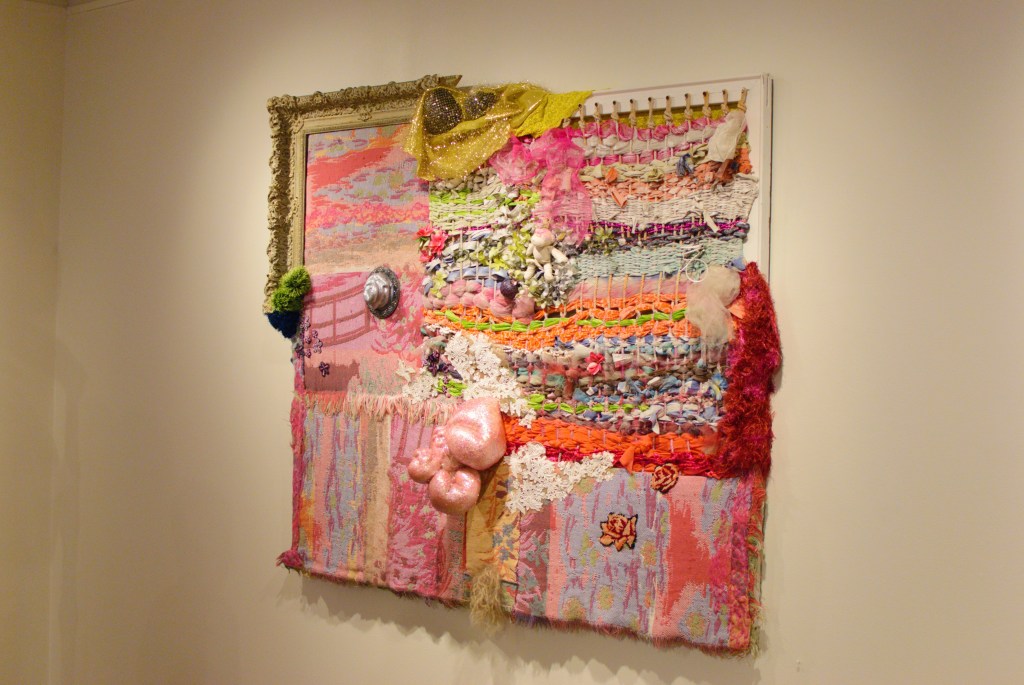
Meier’s exhibition featured a wide variety of work, all of which were intricate, complex and personalized. The installment has changes throughout it’s making, using multiple mediums as well as three-dimensional add-ons such as a variety items, fabrics and materials from different people in her life at different times.
Waubonsee Community College Sophomore Adyana Rogers attended the exhibit and Artist Talk, and not only interpreted the collection similarly to what was intended, but also felt moved by the intimacy that was shared by Meier through the pieces.
“I think it’s interesting because…nostalgia is so strong in life, and it’s so present, but I think sometimes through life we kind of take on caricatures of our childhood trauma. And then it’s amplified into the world in a way that becomes overwhelming, where we kind of have a toxic culture in social media. But I think the way that Meier has portrayed it is genuinely beautiful; it’s so soft. It shows a lot of compassion for herself as well as others who might identify with her,” said Rogers.
She found that the relationship between nostalgia and childhood discomfort was very evident through Meier’s descriptions of different parts of the collection. As these themes are reflected through the physical appearances of each piece, Rogers discussed their eccentric looks with the uncomfortable feelings that viewers may experience.
“I think maybe a lot of people might find it a little bit out there, I will say that. It’s hard to piece together if you look at each individual piece, which is interesting. But when you look at it all together, you see that she’s capturing a lot in one moment,” said Rogers.
Rogers and many others found Meier’s accidental ability to convey intimate, vulnerable experiences within her eccentric pieces to be interesting and admirable. However, that did not replace the viewer’s perceptions or feelings of discomfort, confusion, or disturbance – fulfilling Meier’s intentions.
Beyond the disagreeable life experiences that people undergo, Meier took this exhibition as an opportunity to address the discomfort occurring within America’s political climate. Through the “We Thought We Were Comfortable” exhibition, she hoped to acknowledge unconventional or unsettling topics, but also highlight the privilege of being comfortable and encourage those to look beyond that stance, especially on a societal level.
“I hope [the collection] helps people think about our times right now. I didn’t talk about politics very much in this talk – maybe alluded to it and the title alludes to it. I’ve been around and know history well enough that there’s always something that’s going on in the world that’s uncomfortable, you know? People starving and all these horrible things that happen. Right now, I feel like for me and many of my friends and neighbors, it’s an uncomfortable time to have a government that’s so antisocial,” said Meier. “It’s like, oh, I’m comfortable. I have a comfortable life, and I know a lot of people don’t, and I don’t think it’s fair.”
The exhibition directly reflects its title through its disturbing, eccentric visual elements and personalized commentary from Meier’s life experiences, offering a space to immerse yourself in the uncomfortable. The “We Thought We Were Comfortable” collection will be available to the public and on display until Oct. 24 at the Arrowhead Gallery.


Leave a Reply